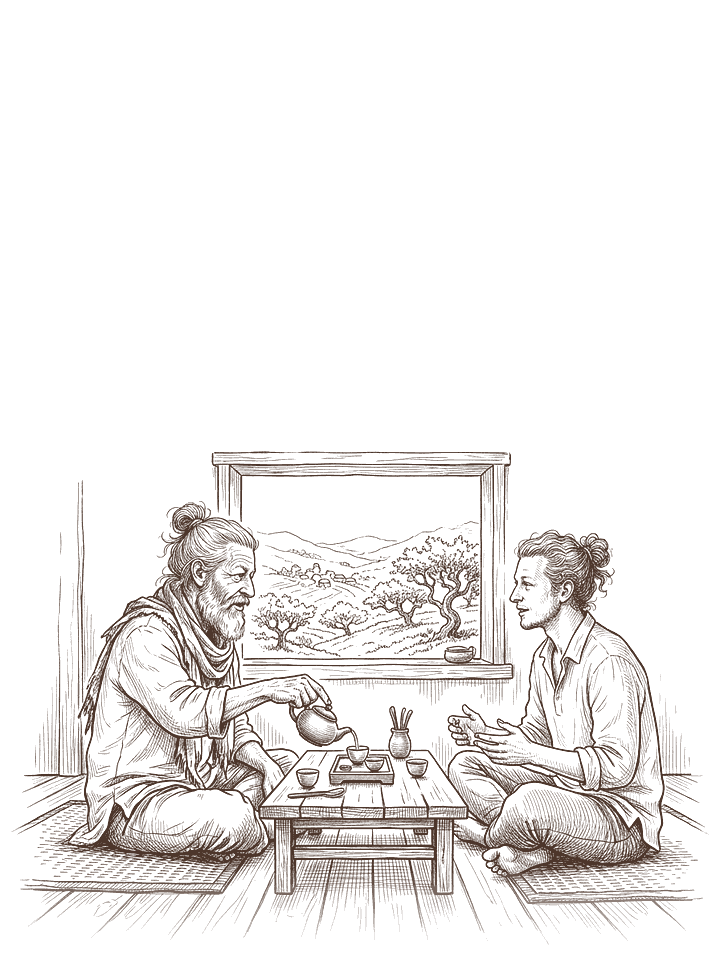
Look at who grows, makes, serves and shares the drink when you want to understand tea culture. Cups are part of the picture, alongside family habits, shop conversations and the landscapes where tea is grown.
Food & Nutrition · Tea
Chinese tea culture in everyday life
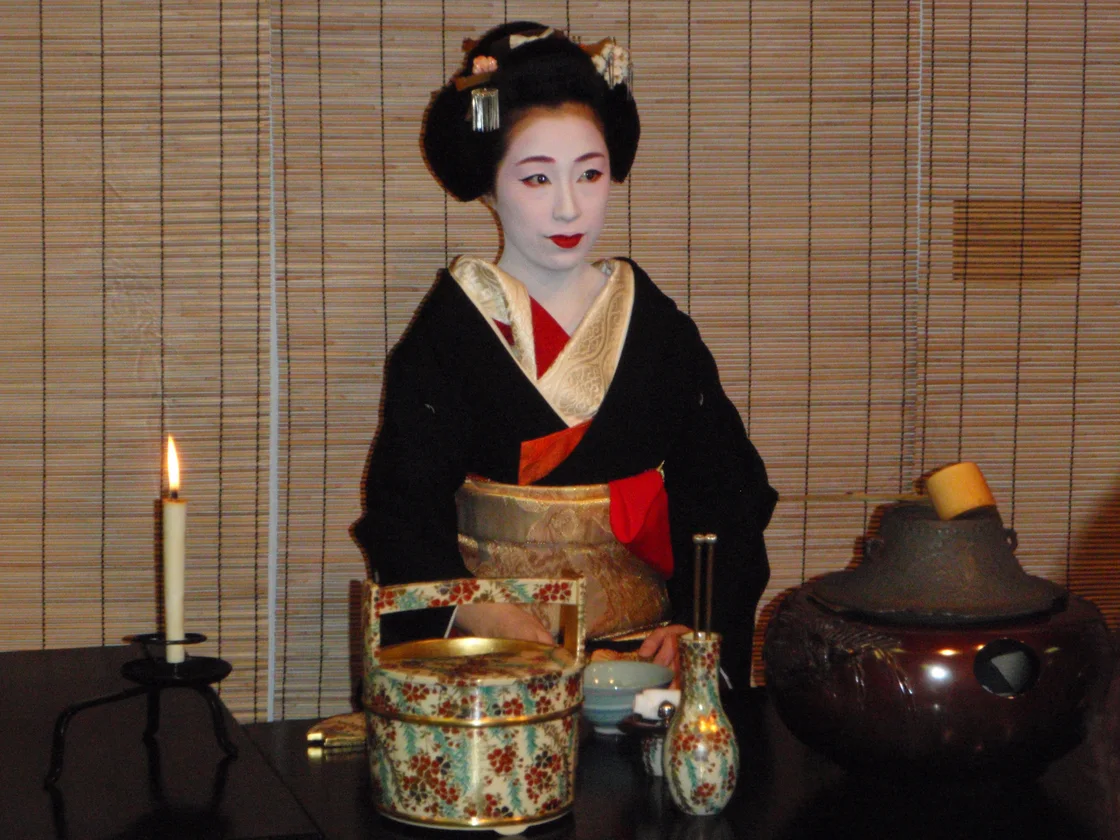
A Japanese tea ceremony before Kamogawa Odori in Kyoto, photographed in 2010. This photograph shows a different tea tradition from the Chinese practices discussed here.
Tea ceremony in Kyoto — Olivier Lejade. CC BY-SA 2.0. Proportional resizing and WebP conversion; no crop or retouching. The original licence also applies to these derivatives.
Start with a particular place
There is no single scene that can stand for all Chinese tea drinking. UNESCO’s description of China’s tea-processing techniques and associated social practices includes homes, workplaces, tea houses, restaurants and temples. It connects the drink with hospitality, relationships, ceremonies and the passing of knowledge through families and apprenticeships. The inscription recognizes a living range of skills and practices. [1]
Begin with a question about a particular practice rather than learning a performance first. “The Chinese tea ceremony” does not name one arrangement shared by every setting.
Ask where the practice comes from and what occasion it serves. A welcome at home and a public teaching demonstration may lead people to make different choices.
The landscape is part of the story
At Jingmai Mountain in Yunnan, the cultural landscape recognized by UNESCO includes old tea groves, forests and villages. Its account identifies the Blang and Dai peoples and describes understorey tea cultivation together with local governance and beliefs. Tea there is connected with land use and community life, not only with the contents of an individual cup. [2] The first episode of our video series, Episode 1: Pu-erh, takes the viewer to an ancient tea forest on Jingmai Mountain.
Use a famous landscape to learn about its communities, while keeping product claims separate. An old-tree photograph or heritage designation does not authenticate an unrelated packet’s origin, age or quality.
Customs travel with people
The Hong Kong Museum of History has documented gongfu tea within the food culture brought to Hong Kong by people from the Chaozhou region. Its exhibition connected food practices with community identity and the experience of migration. This is a reminder that tea traditions do not remain fixed in one place. People carry them into new homes, shops and neighbourhoods. [3]
The word gongfu is often encountered by English-speaking tea drinkers alongside small vessels and repeated infusions. The equipment can make it easy to compare changes in one tea across a session. For the informal session below, collecting each infusion in a separate heat-safe vessel before sharing it is a practical option. This is an editorial hosting suggestion, rather than a claim that every tradition uses the same equipment.
If you share a method, be specific about where you learned it: a supplier’s demonstration, a teacher’s approach or a practice you use at home.
Objects hold stories too
Tea ware can tell a story about trade and adaptation as well as brewing. An exhibition at Hong Kong’s Flagstaff House Museum of Tea Ware examined Chinese export wares and their decorative influence in Southeast Asia and Europe. The objects showed how forms and designs travelled with changing markets and tastes. [4]
For a cup you use at home, ask who made it and how it came to be used that way. Choose what you can handle, pour and clean comfortably, and leave unknown history open rather than supplying a story.
Host a simple tea conversation
Here is a short, informal session you can arrange with a friend. It is an original hosting suggestion, not a reconstruction of a named ceremony.
- Make people comfortable. Choose one identifiable tea, a vessel you can handle and clean cups. Ask whether your guest wants tea, offer water too and keep any blend’s ingredients available. Refills are optional.
- Share what you know. Show the packet and name the stated origin and maker. Attribute a seller’s story to the seller. Invite your guest to smell a little dry leaf from a clean dish if they wish.
- Brew and notice. Use an appropriate method and explain your leaf amount and timing. Let the cups cool. Ask, “What do you notice?” before reading tasting notes aloud. A texture, an everyday aroma or simply a preference is enough; this is not an expertise test.
- Let the session find its pace. Offer another infusion if it suits the tea and everyone wants one. Compare what changed, or let the conversation move elsewhere. Keep one short note if there is something you want to remember.
Keep producers visible
Tea education can connect readers with working communities. The Pinglin Tea Museum in New Taipei City explicitly includes cultural exchange, education and the local tea economy in its mission. Its account places the museum within a region where Wenshan Baozhong production is important. [5]
Keep the maker visible when the information is reliable. Credit the person in a photograph and name the work they did—growing, processing, blending or selling—without assuming those jobs belong to one person.
Choose one question beyond whether the tea is good: about the plant, processor, vessel or way of sharing it. Follow it far enough to learn something specific. An ordinary cup can be a place to learn without becoming a formal ceremony.
From Pavel’s tea table
Personal experience — Pavel Rachkouski, founder. One person’s notes, not advice.
Turkish tea drinkers are a breed of their own. They keep topping up your glass. They use two-tier teapots: boiling water on top, and below it the tea, brewed very strong. I like it: it’s fairly strong and has its own fun taste. I could easily drink ten glasses; sometimes with sugar, sometimes without, and it’s nice that both work. Nothing about it annoyed me; it surprised me more. People drink strong tea all day and smoke cigarettes on top, and that seemed strange to me. I lived in Turkey for a year and a half and sat at the same table with Turkish people more than once; I have Turkish friends.
In Dubai, before the heat, friends used to come over and we sat in the park drinking tea. Usually that went together with me playing sound healing for them. Afterwards they got up, we drank tea, and they shared how good it had been: someone felt as if they were levitating, someone meditated, someone rested, someone dozed off. My best friend lives in my building; he comes up to my place, and we regularly drink GABA together.
This is how such an evening goes: we arrive, sit down, say hello and talk for 10–15 minutes while everyone gathers. Then I say: let’s lie down and close our eyes. I play for about 45 minutes, mostly the hang, singing bowls and Koshi chimes. Then I bring people up, and we sit for about 10 minutes, meditating and coming back to ourselves. Then I pour the tea, and we drink it and talk. After playing it’s almost always a green pu-erh; I try to brew it stronger, so that it properly wakes people up.
My girlfriend and I drink the same tea. We decide together: we choose the flavour, the notes, how strong, how many grams. We drink it playfully: we decide how much it will be, and we drink.
Sources
- UNESCO Intangible Cultural Heritage. Traditional tea processing techniques and associated social practices in China. Inscribed 2022; checked 16 October 2026.
- UNESCO World Heritage Centre. Cultural Landscape of Old Tea Forests of the Jingmai Mountain in Pu’er. Community, landscape and cultivation context; not a product authentication source.
- Hong Kong Museum of History. Chaozhou Food Culture in Hong Kong. Past exhibition, 2012; used for its documented cultural account, not current visitor information.
- Hong Kong Leisure and Cultural Services Department Museums. Behind the Art: Chinese Export Tea Ware. Past exhibition, 2018; object and cultural-exchange context.
- Pinglin Tea Museum of New Taipei City. Introduction and core mission. Page updated 2025; checked 16 October 2026. No unverified current attendance or economic statistics used.