Green tea is made by applying heat to plucked leaves early — by steaming or by pan-firing — to inactivate the leaf enzymes responsible for much of their oxidation. The heated leaves are then rolled, shaped and dried. Oolong manufacture allows withering and carefully managed leaf disturbance before the heat-fixing stage, and black-tea manufacture involves more extensive leaf disruption.
Begin with what happened to the leaf, rather than expecting one flavour from green tea. A steamed, needle-shaped tea and a rounded, pan-fired tea can share the category while needing different treatment in the pot. The packet’s processing story gives you a useful place to start.
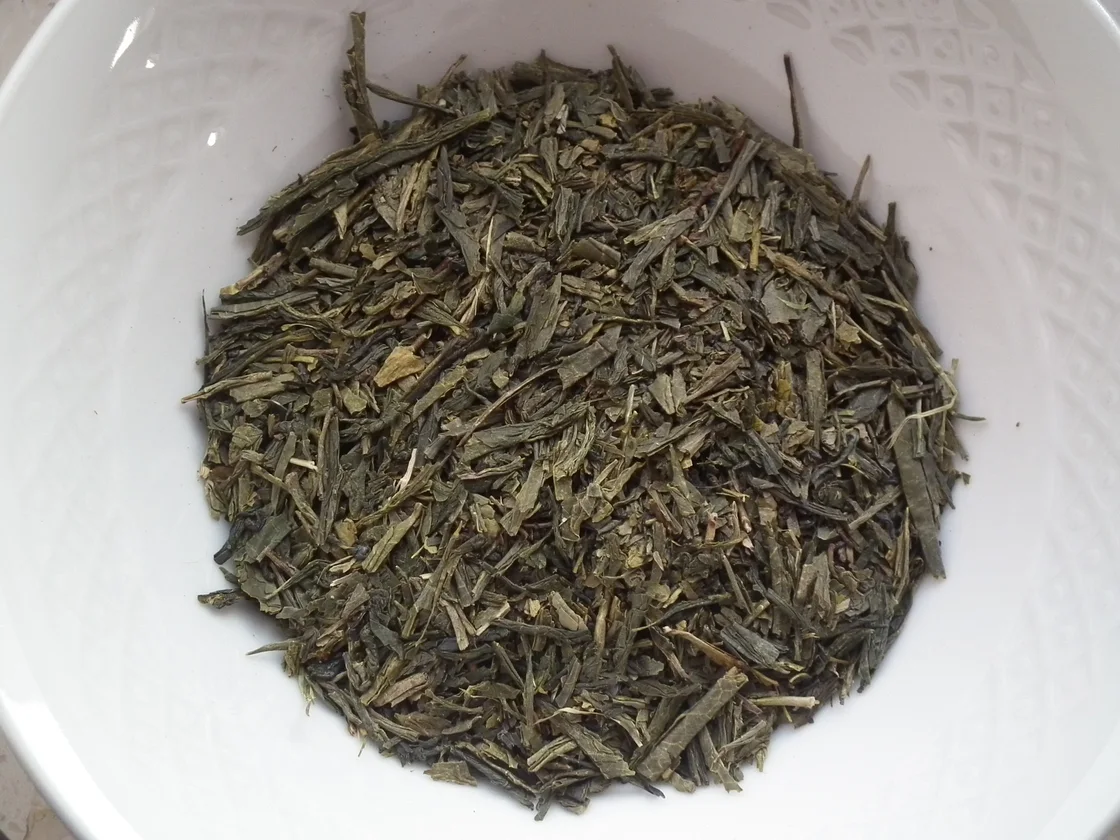
Dry sencha green tea leaves on a white plate.
Green tea Sencha — Stefan Kühn. CC BY-SA 3.0. Proportional resizing and WebP conversion; no crop or retouching. The original licence also applies to these derivatives.
The early decision that makes a green tea
In green-tea manufacture, heat is applied early to inactivate the leaf enzymes responsible for much of its oxidation. Steaming and pan-heating are two ways of doing this. Rolling, shaping, drying and finishing then turn the heated leaf into a usable product. Green tea has undergone substantial processing; the aim is to control particular changes, rather than leave a plucked leaf untouched.[1]
Oolong takes a different route. Its manufacture allows withering and carefully managed leaf disturbance before the heat-fixing stage. Black-tea manufacture involves more extensive leaf disruption and enzymatic oxidation. Research presented at the International Conference on O-CHA describes these as different ways of using the leaf’s own enzymes during manufacture.[2] The familiar green–oolong–black sequence is therefore a useful outline, but it should not reduce three complex production traditions to a colour chart.
If colour and category seem at odds, ask about the process. A green-looking oolong is still oolong, and a strongly toasted green tea has not become black tea. Appearance is one observation, not the classification rule.
Steamed and pan-fired are starting points
Steaming supplies heat through steam; pan-firing uses contact with a heated surface. The World Green Tea Association describes both as ways of inactivating enzymes, with subsequent shaping and drying varying by tea.[1] Longjing, a Chinese green tea, gets its flat, smooth leaves from pan-processing in stages. These words tell you something practical about manufacture, but they do not provide a complete tasting note.
Nor do they divide the world neatly into two countries. Japan produces pan-fired tamaryokucha as well as steamed teas. A brewing guide hosted by Japan’s Ministry of Agriculture, Forestry and Fisheries treats pan-fired tamaryokucha separately from sencha and from deeply steamed fukamushi sencha.[3]
That last distinction matters. The same guide explains that longer steaming leaves fukamushi sencha more fragmented, with fine particles contributing to the drink’s appearance and texture. It recommends a shorter infusion than for ordinary sencha.[3] A packet of small pieces may be a characteristic of the intended production style. Judging every green tea by how many immaculate whole leaves it contains will lead you astray.
Buy a comparison you can explain
For a first useful comparison, choose two small packets with clear descriptions: one explicitly steamed, the other explicitly pan-fired. Record the tea name, origin and harvest information exactly as supplied. If the seller does not give a harvest date, leave the field blank rather than turning a packing date into one.
Read the directions in the context of the method: repeated infusions in a small pot, a full mug or something else. Check the leaf and water amounts as well as temperature before using the instructions as a starting point.
Match the preparation to equipment you can use. Fine leaf needs a strainer that retains it. A tall glass lets you watch leaves open but leaves them steeping as you drink; that differs from emptying a pot at a fixed time.
Write your own observations before returning to the seller’s notes. Expecting grass from one tea and nuts from another can otherwise become the whole comparison.
A two-cup temperature exercise
The most revealing first experiment uses one tea, not two. This separates a brewing change from a change of leaf.
Start with the packet’s instructions for that specific tea. Write down leaf weight, water volume, temperature and infusion time. If instructions are missing, ask the seller for a starting method before using an expensive sample.
Prepare two equal portions in matching vessels. Use the same water and leaf weight for each. Keep the water volume, infusion time and pouring method the same.
Brew one at the suggested temperature and the other about 10°C cooler. This is a comparison chosen for this exercise, not a claim that every green tea has a preferred ten-degree range.
Strain both completely. Let them reach a comfortable drinking temperature before comparing aroma, savouriness, bitterness and the drying sensation in the mouth.
Name the trade-off. Perhaps the cooler cup seems gentler but less aromatic; perhaps you prefer the original. Either result gives you a direction for the next pot.
If the difference is unclear, repeat on another day rather than changing four variables at once. You are learning the response of this packet, in your water, with your equipment.
Use the MAFF-hosted guide’s combination of tea type, vessel, water and technique rather than memorising one temperature for all green tea.[3] Once you can repeat a cup, change one detail at a time and keep the adjustment you actually prefer.
From Pavel’s tea table
Personal experience — Pavel Rachkouski, founder. One person’s notes, not advice.
I like tea in general. I drink about 100 different teas a year; if I remembered all their names, I would have nothing but tea in my head. For myself I sort them simply. The heavier, darker pu-erhs, and even green pu-erh, I call, half-joking, the strong, heavy teas. GABA and the softer oolongs I put next to green tea: lighter and gentler.
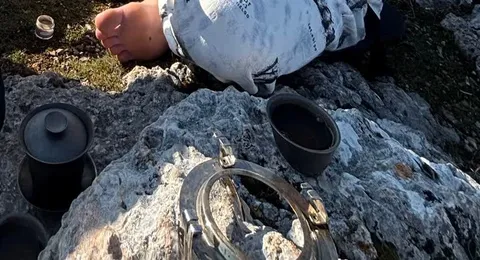
At Al Qudra lake in Dubai we drank two GABA teas from Taiwan Tea Crafts, lot 1535 and lot 1527, from the camping tea things we took with us.
The tea I remember best was on my birthday. A friend opened a green pu-erh, an exclusive one; he said I would hardly ever taste anything like it again. It was soft and grippy. That’s what I like about green tea: it grips. If you overbrew black tea, it grips and is unpleasant; some green teas grip and are unpleasant, they’re bitter, and some grip and are soft. That one was exactly like that. Afterwards I really wanted to talk and to move, so we did some yoga. I caught a great state from that tea.
Tea on a hilltop on my birthday — the gaiwan, a cup and the kettle on a rock
Frequently asked questions
What is the difference between steamed and pan-fired green tea?
Steaming supplies heat through steam; pan-firing uses contact with a heated surface. Both inactivate the leaf enzymes, and later shaping and drying vary by tea. The words describe manufacture, not a complete tasting note, and they do not divide the world into two countries: Japan also produces pan-fired tamaryokucha.
Can I tell green tea by its colour?
Not reliably. A green-looking oolong is still oolong, and a strongly toasted green tea has not become black tea. Appearance is one observation, not the classification rule.
Why is my green tea bitter?
Water temperature is part of the answer. Japan’s Ministry of Agriculture, Forestry and Fisheries explains that umami components such as the amino acid theanine come out even at lower temperatures, from 50°C (122°F), while the astringent and bitter components, catechins and caffeine, come out at high temperatures of 80°C (176°F) and above; to bring out umami, it suggests water below 80°C (176°F). It adds that later infusions made with hotter water and about half the time give a more astringent, bitter cup.[4] Start with the packet’s instructions for that specific tea.