Ask which job the name on the packet identifies: growing, processing, exporting, blending or selling. One business may do several, but the label alone does not tell you which.
In short: the name on a tea packet may belong to the grower, the processor, an exporter, a blender, a packer or the shop — and one business can do several of these jobs. The label alone rarely says which. Ask who did each job for this particular tea, and write “not stated” where nobody says.
Separating the roles gives you a clearer way to read the supplier’s account and ask what still needs explaining.
Growing leaf and making tea are separate jobs
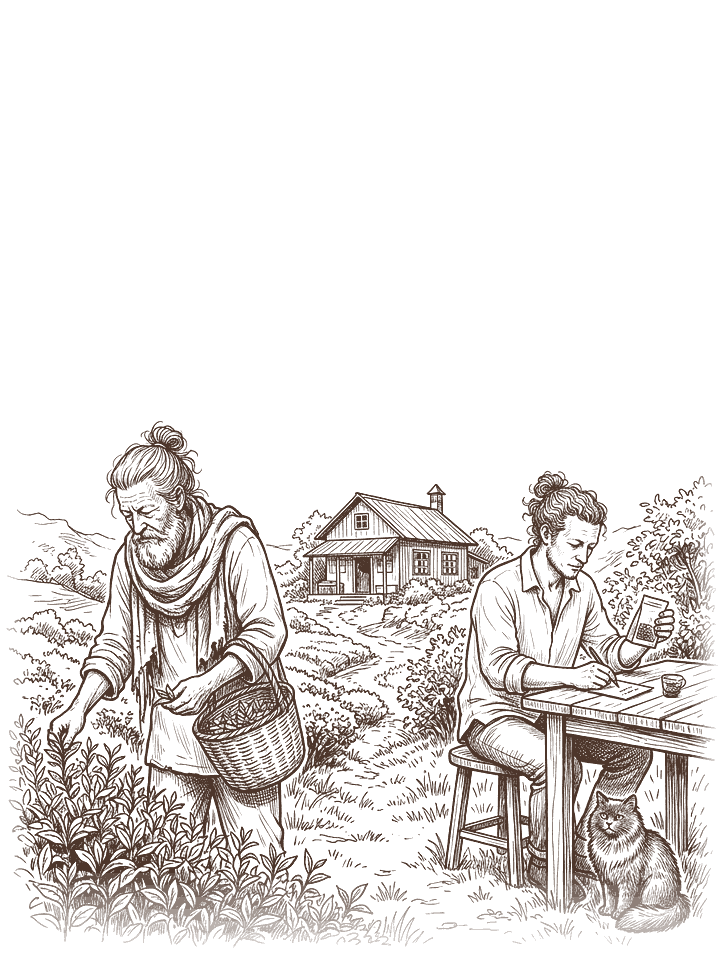
The grower manages the plants and the harvest. The processor turns fresh leaf into finished tea. Those roles can be combined on an estate, but a small grower may supply leaf to a separate factory. FAO’s research on India and Indonesia documents connections between smallholders, leaf agents and processing businesses. [1]
A leaf buyer or collector can sit between them, gathering fresh leaf and arranging its movement to a processor. That is different from a buyer selecting already-finished tea for a shop or blend. When someone says “we buy the leaf,” it is reasonable to ask which material they mean.
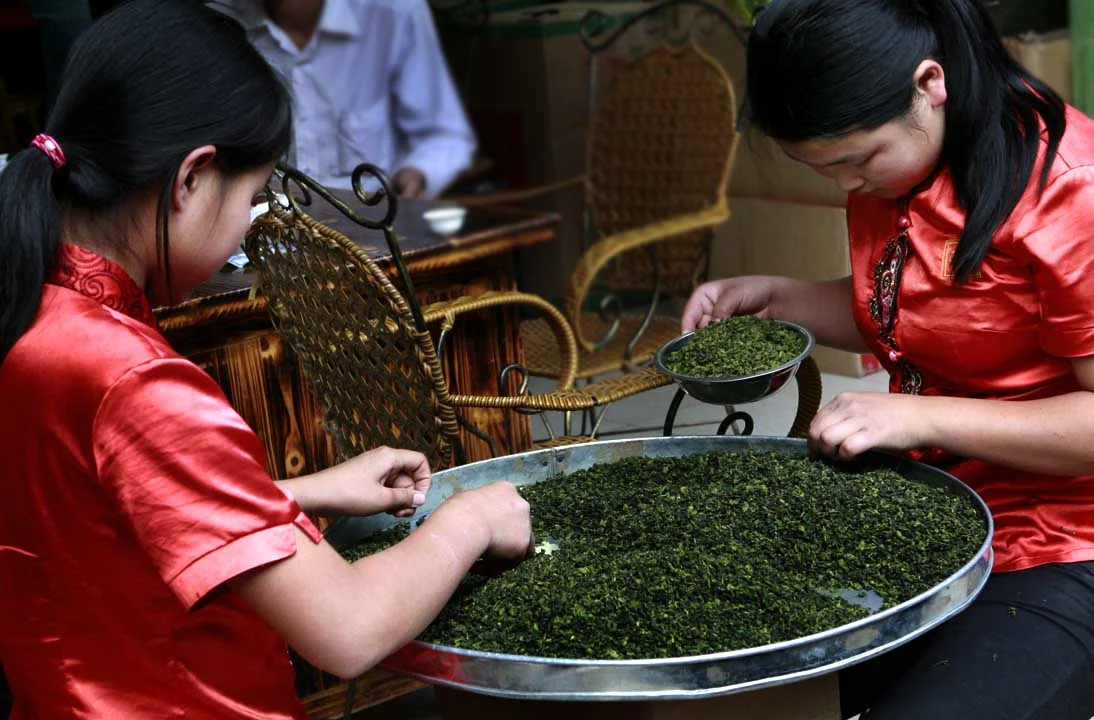
At a black-tea factory, work can include withering, rolling or other leaf disruption, oxidation, drying and sorting. Sri Lanka Tea Board describes these as distinct stages, followed by bulk packing. [2] A factory name therefore identifies important work, but does not by itself identify every farm that supplied a batch.
Finished tea may take several routes
After processing, tea may be sold through an auction, a private trading relationship or a producer’s own sales operation. An FAO case study of Darjeeling describes several distribution channels rather than one fixed path, including producer-processors, brokers, traders, exporters and downstream sellers. It also records producers arranging processing with neighbouring estates. [3]
Use these examples to understand possible arrangements, not as a current map of every supplier. A named origin still leaves the rest of the chain to describe.
A blender selects and combines finished teas for an intended result. The components may come from different lots, seasons or origins, depending on the product. A packer puts tea into the format that is sold or shipped. An exporter organizes the business of selling and moving it to an overseas market. The retailer presents it to the final customer. FAO’s value-chain discussion treats blending and packing as activities beyond primary tea manufacture. [4]
An importer or distributor may also stand between exporter and retailer. A retail brand does not need to grow tea to do useful work; it should be able to explain the work it actually does.
“Direct” needs a second sentence
Read “direct” as the beginning of a sentence: from whom, to whom and for which tea? A retailer buying from a factory and a grower selling tea from an on-site workshop describe different relationships.
Ask for the relationship in ordinary language. “We buy this lot from the processor, which takes leaf from several nearby growers” gives you roles to follow; a dramatic story without those roles may tell you less.
It is also unwise to infer payment or working conditions solely from the number of intermediaries. Fewer steps do not tell you what growers or workers receive. A longer chain does not establish unfairness by itself. Claims about those matters need their own evidence; a beautiful landscape and a retail price cannot supply it.
Ask questions that can be answered
For a tea you are considering, start with these practical questions. They are an editorial checklist, not a demand that every small purchase come with a dossier.
- Which tea is this? Ask for the product name, lot or batch reference, harvest year and season where known. Does the sample correspond to the stock currently for sale?
- Where did the leaf grow? Is the stated origin a garden, a village, a region or a country? Is it one source or several?
- Who processed it? Is the processor also the grower? If the supplier cannot disclose a name, what can they tell you about the production arrangement?
- What happened after processing? Was it blended, scented, flavoured, roasted again or repacked? Ask what the particular description means rather than assuming every product follows the same route.
- What can be linked to this batch? If origin or certification is central to your choice, ask which supporting information applies to this tea and which concerns the business more generally.
- How has it been handled? Ask about packing date, packaging and the supplier’s storage guidance. Keep harvest and packing dates separate in your notes.
Begin with the question most relevant to your purchase.
Keep a modest record of what you learn
Take one packet and its product page. Write a line for growing, processing, blending, packing and selling. Under each, enter the named business or “not stated.” Add the lot reference and where each answer came from.
Separate what is printed on the packet, what the seller explains and what you infer yourself. Leave an unanswered question marked as such. Missing information limits what you know; it is not automatic evidence of wrongdoing.
Return to the record when reordering or comparing a changed blend. It helps you name the work behind the packet and identify what stayed the same. One clear answer at a time is enough to make the next purchase better understood.
Questions people ask
What is the difference between a tea grower and a tea processor?
The grower looks after the plants and the harvest; the processor turns fresh leaf into finished tea. One estate can do both, but a small grower may sell leaf to a separate factory. FAO field research in India and Indonesia describes smallholders, leaf agents and processing businesses linked in this way. [1]
What does “direct trade” tea mean?
There is no single meaning on a packet. Read “direct” as the start of a sentence: from whom, to whom, and for which tea? A shop buying from a factory and a grower selling from its own workshop are both “direct”, but they describe different relationships. Fewer steps alone also say nothing about what growers or workers are paid.
Is a tea blender the same as a tea producer?
No. A blender selects and combines finished teas for an intended result, and the parts may come from different lots, seasons or origins. FAO’s value-chain analysis treats blending and packing as work beyond primary tea manufacture. [4] A brand that blends can still do useful work; it should say which work it does.
From Pavel’s experience
Personal experience — Pavel Rachkouski, founder. One person’s notes, not advice.
My tea reaches me by a few roads. A friend and I put money together and order straight from China; the last parcel brought all kinds of pu-erhs, GABAs and green teas. I’m from Minsk myself, and a friend often goes to see his parents in Belarus; when he is in Minsk, I ask him, and he always buys me something new from Chaynaya Pochta. When he travels through Moscow, he keeps bringing me little sample packs of about 30 grams. In Dubai I have looked: tea is brought in here too, but the prices are not quite healthy. In India I saw tea plantations, but only from a distance; I never walked through them.
My girlfriend had never drunk proper tea before; now she drinks it quite often. A friend from Minsk didn’t really drink tea either. When I started running sound-healing evenings with tea afterwards, he began bringing me tea from Minsk, and now he buys proper tea for himself too.
My best friend had tried pu-erh before, but in Dubai he saw my tea set and bought himself small teapots and a kettle that keeps the temperature. We order tea from China together. He doesn’t drink it as much as I do, but he drinks it.
Sources
- FAO. Traceability, supply chains and smallholders: case-studies from India and Indonesia, 2006. Historical field research used for producer/agent/processor arrangements, not current statistics or regulations.
- Sri Lanka Tea Board. Manufacturing. Processing stages and bulk packing; checked 16 October 2026.
- Tarit Kumar Datta. Darjeeling tea, India, in FAO’s Quality linked to geographical origin and geographical indications: lessons learned from six case studies in Asia, 2010, pp. 128–131. Historical examples of combined roles and distribution channels.
- FAO. Upgrading in the international tea sector: a value chain analysis, Committee on Commodity Problems, 2005. Used for the distinction between manufacture and downstream blending/packing; no historical prices or margins adopted.