Store loose leaf tea in a well-sealed, food-suitable package in a cool, dry place away from light, heat sources, kettle steam and strong odours such as spices or cleaning products. Keep a small working portion for daily use so you are not opening your whole supply each time, and keep the label with the batch details.
Decide how long you expect to keep this tea before choosing storage equipment. The task is to preserve it until you drink it, taking account of the product, its package and the room it will sit in.
Check the existing cupboard before buying a container. Kettle steam, direct sun and nearby spices may matter more than a new tin. A small supply with clear labels is often easier to use and keep track of than a large collection.
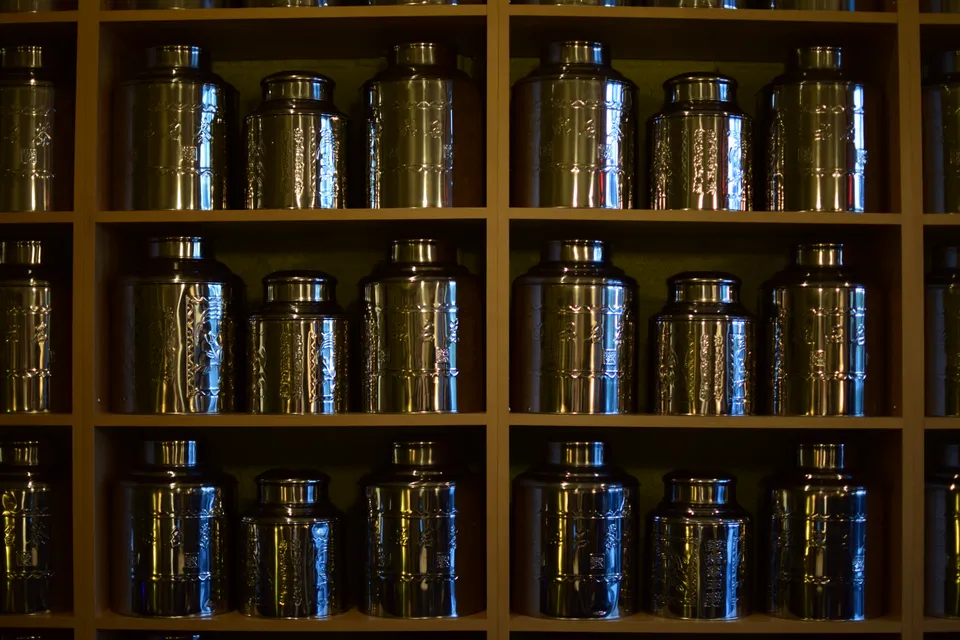
Closed metal tea caddies on shelves in Chicoutimi, Quebec.
2016-10 tea caddy 01 — 0x010C. CC BY-SA 4.0. Proportional resizing and WebP conversion; no crop or retouching. The original licence also applies to these derivatives.
Decide what you are trying to preserve
For a green tea bought for its fresh character, the aim is usually to slow unwanted change. A roasted oolong also needs protection, even when its aroma differs greatly from a green tea. Roast is not a substitute for a sound package.
Pu-erh introduces another intention: some drinkers want to observe the tea changing over time. Storage can affect its appearance, aroma and taste, as Yuxi’s official consumer guidance explains.[1] That does not make every change desirable or turn every spare cupboard into a suitable ageing environment.
Separate keeping next month’s tea in good condition from ageing a cake for years. The first is an everyday storage task; the second needs a longer record and leaves more uncertainty than a simple tip can resolve.
Give everyday tea a protected home
Taiwan’s Ministry of Agriculture recommends suitable sealed food packaging, protection from light and a cool, dry location. Its home-storage guidance also warns against odours and nearby heat sources.[2]
Translate that into a quick cupboard check:
Move tea away from the kettle’s steam and the cooker.
Avoid a sunny shelf or a cupboard that becomes hot beside an appliance.
Keep it separate from cleaning products, strongly scented food and fragranced items.
Check that the package closes properly and has no tears.
Use a clean, dry scoop, then close the packet before preparing the drink.
You can keep a sound inner pouch inside a tin rather than emptying everything into a decorative container. If you do transfer tea, retain the label and batch details. Choose food-suitable storage with no lingering smell; an attractive jar that previously held coffee may be a poor choice.
Make smaller working portions
The Tokyo Tea Cooperative recommends dividing Japanese tea into small supplies and limiting exposure to air.[3] The useful household principle is to avoid repeatedly opening your entire reserve whenever you make a cup.
Choose a working portion around the pace at which you drink that tea, rather than someone else’s fixed number of days. Keep the reserve labelled and appropriately sealed, using clean, dry equipment to refill.
This is especially helpful when you have several teas open. Put an opening date on each packet and keep a short list of what is ready to drink. It reduces the chance of forgetting a delicate tea while working through a much larger bag of something else.
Use cold storage deliberately
Research on Huangshan Maofeng compared several storage temperatures over as long as 150 days and found differences in sensory freshness and aroma composition.[4] That supports taking temperature seriously. It does not establish one household temperature or shelf life for every green tea.
Follow the maker’s instructions for the product and package. If you use a refrigerator or freezer for reserve tea, protect it fully from moisture and food odours. Keep it in separate portions rather than repeatedly moving one large package in and out.
Let a cold, sealed portion return close to room temperature before opening it. Taiwan’s guidance specifically explains that opening cold tea too soon can lead to moisture condensation and faster deterioration.[2] The Tokyo cooperative gives the same practical instruction.[3]
Compare the whole arrangement, not temperature alone. A daily packet on a suitable shelf may be easier to manage than a poorly sealed one in a busy fridge. Cold storage depends on the packaging and handling working with it.
Does tea expire?
Tea does not come with one expiry date that fits every leaf. The sources used here do not give a universal “good for X years” figure, and this guide does not invent one. What they describe is how storage method and time work together.
Taiwan’s Ministry of Agriculture tea research station gives these ranges: short-term storage (within about one month) or lower-grade tea can stay at room temperature; for storage of up to six months, a refrigerator at 0–5 °C (32–41 °F) is described as the most economical choice; for more than six months, freezing at −10 to −18 °C (14 to 0 °F) is preferred. For fine green teas such as high-grade Japanese sencha, Longjing or Biluochun it recommends cold storage whatever the length.[2]
So “is this old tea still good?” is a question about condition, not only age. Check the packaging, smell and dryness first. If the tea smells musty, feels damp or shows mould, do not drink it.[5] A tea that is merely stale will taste flat.
Pu-erh is the exception in how people think about age: some drinkers keep it for years on purpose. That is a separate, riskier project (see the pu-erh section below), not proof that any old tea is fine.
Keep pu-erh experiments modest
For a cake you intend to drink soon, begin with the supplier’s instructions and the cleanest, most stable suitable place you have. Keep it away from leaks, damp walls, direct sun and odours. Retain its wrapper and identifying information, and use any additional protective packaging recommended for that tea and your circumstances.
Sources do not agree on one humidity number. Wikipedia gives 60–85 % relative humidity for ageing pu-erh, a figure it takes from a tea shop and itself marks as needing a better source.[6] White2Tea, a tea seller, suggests keeping the room at 60 % or lower to reduce the risk of mould.[7] Path of Cha, another seller, aims for about 65 % for sheng and 60–65 % for shu, warns that humidity kept above 70 % raises the risk of mould, and adds that most of the Yunnan tea masters it consulted advised about 50 % or even lower.[8] For temperature it suggests ordinary room temperature, about 18–25 °C (65–75 °F), without daily swings.[8]
A room reading still cannot describe every part of a cake or every enclosed container, and the goal is not simply to make a number rise. Advice for humid southern China differs from advice for a dry desert climate.[7] Ask an experienced supplier about your actual climate and intended storage period before adding active humidity control.
Do not spray the leaves, place water against the cake or use a damp enclosed box to accelerate change. Warm, humid conditions favour mould growth; official food-safety guidance advises keeping dried foods cool and dry.[5] Uncontrolled wet storage is an unnecessary experiment with tea you plan to drink.
If you want to observe ageing, start small and record changes of container and location with dates. Compare later cups with earlier notes, while allowing for differences in memory and brewing as well as the tea. How sheng and shu differ, and how each is usually stored, is on the sheng pu-erh and shu pu-erh pages.
Inspect condition without trying to rescue everything
Check stored tea periodically, especially after a leak, unusually humid weather or a move. Look for damaged packaging, dampness, pests or unexpected growth. If its condition is uncertain, set it aside and ask the supplier rather than tasting it to investigate.
Do not drink mouldy tea. Removing a visible patch is not a reliable way to make mouldy food acceptable, according to Hong Kong’s Centre for Food Safety.[5] Rinsing or home roasting should not be treated as a rescue method.
Keep the system simple enough to use: a suitable place, dependable packaging, clear identification and an amount you can realistically drink. Solve those details before planning a tea room.
From Pavel’s tea table
Personal experience — Pavel Rachkouski, founder. One person’s notes, not advice.
My tea lives in a big ordinary biscuit tin, just on the table. It’s one tin, and a whole bag of tea just sits in it. In my flat in Dubai it is always 24–25 °C. I have never had a problem with it: nothing went stale, no smell appeared, nothing got damp. I never just drop tea somewhere and forget it; I always put it in a decent place.
One brew is 7 grams, twice a day. Sometimes I don’t drink tea at all for three weeks; in those weeks I drink water and coffee, sometimes soda or mineral water. That’s about 420 g a month if I drank every day; cakes vary — I’ve seen 200, 300 and 500 g ones.
Pavel keeps his tea without any special conditions: one biscuit tin on the table, in a flat in Dubai that stays at about 24–25 °C. That is one household’s experience, not a storage test, and it is not the advice on this page. The guidance above comes from the sources listed below.
Frequently asked questions
Do I need a special tea tin?
Not necessarily. Check your existing cupboard first; a sound inner pouch can stay in a tin or cupboard. If you transfer tea, choose food-suitable storage with no lingering smell and keep the label and batch details.
Should loose leaf tea be refrigerated?
Follow the maker’s instructions for the product and package. Research on one green tea found that storage temperature affected freshness, but it does not establish one household rule. If you use a refrigerator or freezer for reserve tea, protect it fully from moisture and food odours, keep it in separate portions and let a cold, sealed portion return close to room temperature before opening.
How long does loose leaf tea last once opened?
Taiwan’s Tea and Beverage Research Station explains that once a packet is opened, contact with air, light, temperature and humidity makes the flavour fade gradually, and it treats room-temperature storage as suitable for short-term keeping of up to a month, though it advises cold storage for high-grade green teas such as sencha, Longjing or Biluochun.[2] There is no single answer: it depends on the product, its package and your room. Put an opening date on each packet and keep a short list of what is ready to drink.
Is storing pu-erh different?
Some drinkers want to observe pu-erh changing over time. That is a different aim from keeping everyday tea fresh.
How should I store pu-erh tea at home?
For a cake you intend to drink soon, begin with the supplier’s instructions and the cleanest, most stable suitable place you have. Keeping next month’s tea in good condition is a different aim from ageing a cake for years; do not spray the leaves, place water against the cake or use a damp enclosed box to accelerate change.
Can pu-erh tea go bad?
Yes. Warm, humid conditions favour mould growth, and you should not drink mouldy tea; removing a visible patch is not a reliable way to make mouldy food acceptable.[5] Yunnan’s Yuxi city government also tells buyers that an off smell in dry pu-erh is a sign of poor quality.[1]
Does pu-erh tea expire?
Not on a fixed date. Wikipedia says pu-erh can be aged, but age is not the only measure of its quality: like wine, a tea reaches a peak and can decline afterwards, and the best age differs from batch to batch, from about 10 years to 20 or 30 and more.[6] Condition still comes first: do not drink mouldy tea.[5]
What humidity is best for storing pu-erh?
There is no agreed number. Advice runs from about 50 % (Yunnan tea masters consulted by Path of Cha) and 60 % or lower (White2Tea) to 60–85 % (Wikipedia), and Path of Cha warns that above 70 % the risk of mould grows.[6][7][8]
How should I store Longjing or other green tea?
For a green tea bought for its fresh character, the aim is usually to slow unwanted change. Keep it in a well-sealed, food-suitable package in a cool, dry place away from light, heat sources, kettle steam and strong odours, with a small working portion for daily use. Research on Huangshan Maofeng found differences in sensory freshness at different storage temperatures, but it does not establish one household temperature or shelf life for every green tea.
Sources
Yuxi Municipal Market Regulation Bureau and Yuxi Consumers Association. Pu-erh tea consumer warning, 26 November 2024. Opening discussion of storage-related changes; Chinese-language source.
Taiwan Ministry of Agriculture, Tea and Beverage Research Station. How to store tea. Official home-storage guidance, updated 17 October 2024; Chinese-language source.
Hong Kong Centre for Food Safety. Mouldy Food and Food Safety. Food Safety Focus, February 2023. General dried-food storage and mould-disposal guidance.
Wikipedia. Pu’er tea, revision 1379992802 of 13 October 2026, section “Aging and storage”. General reference; anyone can edit it.