To brew tea well, start with the maker’s directions, then record four things: dry leaf amount (grams or a consistent spoon), water volume, water temperature and infusion time. Change only one of them at a time until you like the cup. As an editorial starting point for a plain whole-leaf oolong in a mug: 3 g of leaf, 250 ml of water at about 90°C/194°F, for two minutes timed from the start of pouring.
Keep enough detail from a cup you enjoy to make it again. Choose one tea, measure a few things and adjust one variable at a time; the record serves the cup, rather than turning brewing into a search for a perfect chart.
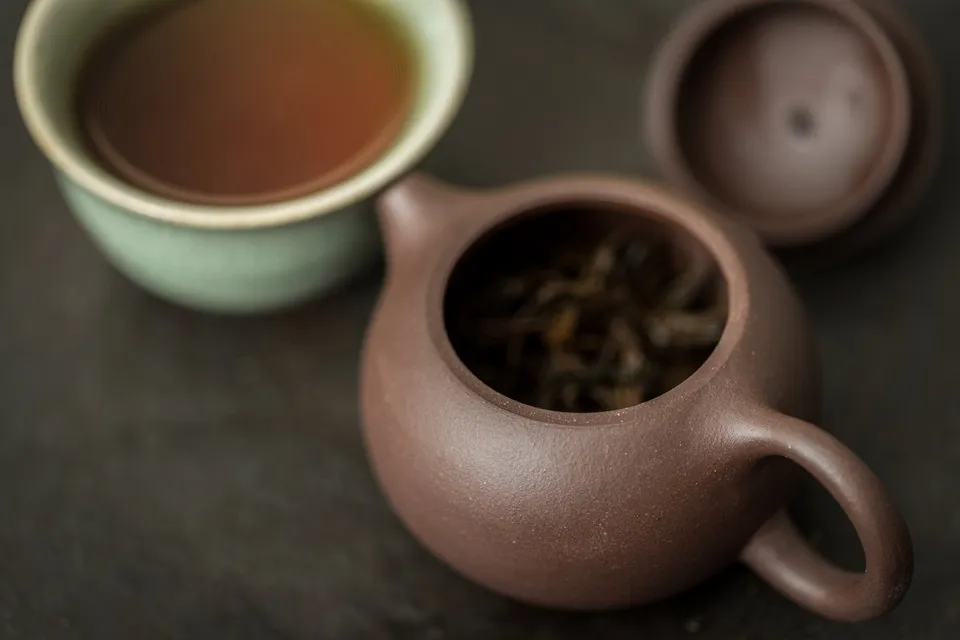
A teapot and cup; the photographer identifies the tea as Lapsang. Used here for general brewing context.
Yixing ware teapot and Lapsang tea — Markus Kniebes. CC0 1.0. Proportional resizing and WebP conversion; no crop or retouching. The original licence also applies to these derivatives.
Begin with the leaf and the vessel
The name of a tea is a starting point, not a complete brewing recipe. A tightly rolled oolong, a loose twisted leaf and a broken piece from a compressed cake behave differently in a pot. Tea-aroma research has tested how brewing time, temperature, leaf size and water hardness change what reaches the cup. In a controlled green-tea experiment, smaller leaf pieces produced faster early extraction of volatile compounds measured above the infusion. [1]
Choose one tea and one vessel for your first few attempts. A mug with a removable basket infuser is enough. The basket should let you remove the leaves without needing to pour hot water through a complicated arrangement. A small pot with a comfortable handle is another option.
Record the water you actually brew with, not the vessel’s brim capacity. A 350 ml mug may be comfortable with 250 ml in it. Leave space for pouring and removing the infuser, then use that working volume in your notes.
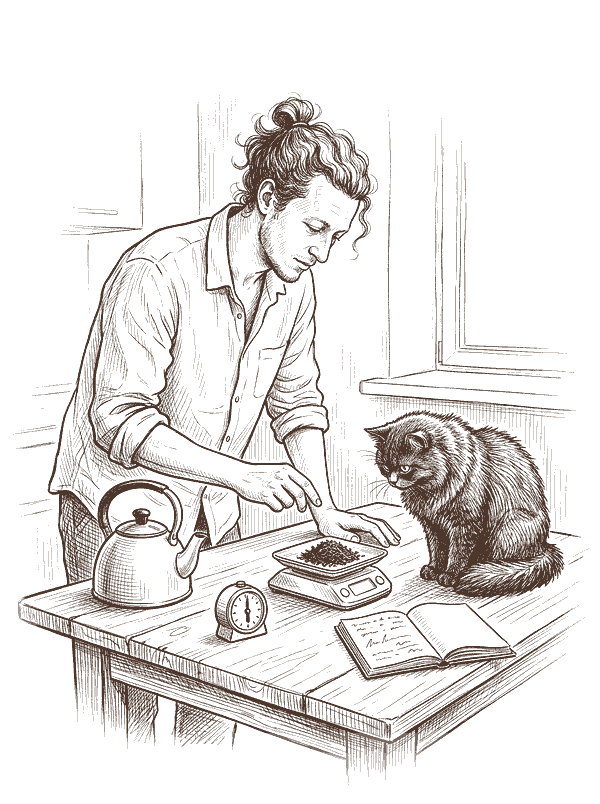
A small scale is useful because a spoonful of tightly rolled leaves and a spoonful of large twisted leaves can represent different amounts of tea. If you do not have a scale, use the same spoon and the same filling method for the same product. That is still more repeatable than an unrecorded handful.
Four things to record
You do not need a laboratory notebook. Put these four details beside the tea’s name:
Dry leaf amount in grams, or your consistent spoon measure
Water volume in millilitres
Water temperature or the preparation instruction you followed
Infusion time, including when you started counting
Choose when the timer starts and use the same convention next time. For a mug, the first contact between water and leaf is a simple starting point. In a small pot, filling and emptying can occupy a noticeable part of the infusion; note a slow pour if it affects the comparison.
The relationship between leaf and water is particularly helpful when changing vessels. If your method uses 3 g in 250 ml, keeping the same ratio in 500 ml means using 6 g. This is simple scaling, not a promise of an identical cup: a larger pot may retain heat differently and take longer to empty.
Try a modest starting recipe
The maker’s directions are the best first reference for an identified product. If you have a plain, whole-leaf oolong without directions, the following is an editorial starting experiment for mug brewing:
Put 3 g of tea into a removable basket in a heat-safe mug.
Add 250 ml of drinking water at about 90°C / 194°F.
Infuse for two minutes, timed from the start of pouring.
Remove the basket fully and let the drink cool to a comfortable tasting temperature.
Write one sentence about what you would keep or change.
These numbers are deliberately a starting point, not a tested optimum for every oolong. A particular roast, leaf form or preference may call for a different method. Do not transfer this short, cooler recipe to dried herbal or fruit infusions: their preparation instructions can serve a hygiene purpose. BfR recommends rolling-boil water and at least five minutes for herbal infusions. [2]
Keep the kettle and cup on a stable surface, use a vessel designed for hot water and leave enough room to handle it comfortably. Brewing temperature is not drinking temperature.
Adjust the cup rather than chasing a chart
Describe the part of the cup you would change before changing the recipe. “Too strong” might mean concentration, dominant bitterness or an unpleasantly drying finish. “Too weak” might mean faint aroma even when the body is sufficient. Those observations lead to different experiments.
For the oolong starting recipe, try one of these next steps:
If the cup is more intense than you want, try less leaf with the same water, temperature and time.
If you want to see what a shorter infusion changes, keep the other settings and try 90 seconds instead of two minutes.
If the cup seems faint, compare it with a new brew using a little more leaf, or a longer time. Choose one change, not both.
If the taste is satisfactory but the aroma feels muted, explore temperature on a later attempt while keeping the other details fixed.
Treat each adjustment as a question about your preference, not a guaranteed improvement. Adding a little drinking water to a brewed cup can help you explore concentration, though it cannot undo everything that happened during infusion.
Keep water steady for the first attempts
Water can change a tea’s appearance, extraction and sensory balance. Controlled studies have produced different preference results with different waters and teas, so neither “tap” nor “bottled” is a universal answer.[3, 4]
Use the same suitable drinking water while you learn how your leaf responds to time and temperature. Later, compare two waters with everything else unchanged. Record which cup you prefer rather than treating a mineral number or a clearer appearance as a quality score.
A small pot is a different method
Short repeated infusions are another way to explore tea; this is known as gongfu brewing, while the single longer mug infusion above is usually called western-style brewing.[7] They often use a smaller vessel and more leaf relative to water than a mug method. For the exercise below, a separate serving vessel is a practical way to collect an infusion before dividing it among cups. This is an editorial suggestion, not a required equipment list for every tea drinker.
If you want to try it, use a small handled pot you can empty comfortably and begin with the supplier’s short-infusion directions. A gaiwan can also be used, but practise its grip and pour with cool water first. Choose a different vessel if handling the bowl and lid feels insecure.
Pour each infusion out completely into another heat-safe vessel before sharing it. Otherwise, leaves left standing in water continue steeping while the first person drinks. Record later infusions separately; the same leaves are changing as the session progresses.
When comparing two recipes, read the leaf-to-water ratio alongside the time. A short-infusion method may use much more leaf; accidentally pairing that amount with a long mug infusion creates a different experiment.
Keep one useful line
Standardized sensory tests and everyday preferences answer different questions. ISO 3103 specifies a method for preparing tea for sensory tests. Its purpose is consistent assessment; it does not select your favorite everyday cup. [5]
Your own short record can be much simpler:
Tea and batch | leaf | water | temperature | time | what changed | would brew again
When you find a method you like, keep it for a while. The useful result is a cup you can repeat without having to adjust it every time.
From Pavel’s tea table
Personal experience — Pavel Rachkouski, founder. One person’s notes, not advice.
I think the person brewing decides how the tea turns out. I brew by feel rather than by the scales: for pu-erh I usually put in about 7.5 to 10 grams, for GABA around 5.
The first tea I would give someone to try is milk oolong. Then, once they have got a taste for it, bring in teas where the flavours clearly change. I think you should open up the taste with softer teas first, and only then give them pu-erhs, because at first a person may not quite understand that earthiness, or the grip of the green ones, or the bitterness.
There is a grip in the green ones, a bitterish one; you notice it in some teas, but not in all. But I believe that in good tea, really good tea, there is no bitterness that properly bites. For me, the first sign of a bad tea is when it is very bitter. Also when the tea is badly overdried, and when it leaves so much sediment that, as you pour it into the cup, it gets right onto your tongue. That is a sign for me already. Well, that’s just for me personally.
That is one person’s rule of thumb. Bitterness can also come from how a cup is made: the section on adjusting the cup above treats it as something to change one step at a time.
Frequently asked questions
How much loose leaf tea should I use per cup?
Follow the packet first. As an editorial starting point for a plain whole-leaf oolong in a mug, this guide uses 3 g of leaf and 250 ml of water at about 90°C/194°F for two minutes. Keep a ratio you can scale: if 3 g in 250 ml works, 6 g in 500 ml keeps the same ratio, though a larger pot may retain heat differently.
Do I need a scale to brew tea?
It helps, because a spoonful of tightly rolled leaves and a spoonful of large twisted leaves can be different amounts of tea. Without one, use the same spoon and the same filling method each time.
Can I use the same method for herbal tea?
No. Germany’s Federal Institute for Risk Assessment recommends rolling-boil water and at least five minutes for dried herbal infusions.
When should I start the timer?
Pick one convention and use it every time. For a mug, the first contact between water and leaf is a simple starting point.
Can loose leaf tea be reused?
Short repeated infusions are another way to explore tea. They often use a smaller vessel and more leaf relative to water than a mug method. Begin with the supplier’s short-infusion directions, pour each infusion out completely, and record later infusions separately: the same leaves are changing as the session progresses.
What is gongfu brewing?
China’s national intangible cultural heritage list includes Chaozhou gongfu tea art (潮州工夫茶艺), listed in 2008: a tea-brewing technique handed down in the Chaoshan area of Guangdong. It follows a set sequence of steps, among them warming the pot with boiling water, rinsing the tea, pouring water from a height and scalding the cups, and it mainly uses oolong tea.[6] On this page, short repeated infusions in a small pot are the related method: begin with the supplier’s short-infusion directions.
What is the difference between gongfu and western-style brewing?
Gongfu brewing uses a small vessel, often 60 to 200 ml, with more leaf for the amount of water than western-style brewing, and a series of short infusions: the first pours can be as short as 10 to 15 seconds, with later ones gradually longer.[7] Western-style brewing is closer to the mug recipe on this page: less leaf, more water, one longer infusion. Neither is the correct way for every tea. When comparing them, read the leaf-to-water ratio together with the time, as described above. How Pavel brews this way: Sheng pu-erh, from Pavel’s tea table.
Is gongfu Chinese or Japanese?
Chinese. The method probably grew out of tea-making in Fujian and the Chaoshan area of eastern Guangdong.[7] China lists Chaozhou gongfu tea art as national intangible cultural heritage.[6]
Is it gongfu or kung fu tea?
Both spellings are used. The Chinese name, 工夫茶 or 功夫茶 (gōngfū chá), is usually translated as “making tea with skill”.[7]