Personal experience — Pavel Rachkouski, founder. One person’s notes, not advice. Prepared with AI assistance.
In short: ivan chai — also sold as Ivan tea, Koporye tea or fireweed tea — is an infusion of fireweed leaves (Epilobium angustifolium), not of the tea plant Camellia sinensis [1, 2]. Pure fireweed is commonly described as caffeine-free, but many packets are blends, so read the whole ingredient list [3]. For me, how good it is depends a lot on where it comes from.
The best ivan chai I ever had
With ivan chai I have an interesting relationship, and a few stories.
The best one was in Belarus, around 2017. A friend and I told his mother that we wanted some ivan chai. And she really went to the trouble.
She went out somewhere into the fields and picked the fireweed herself. She brought it home and fermented it herself, with her own hands. She told us about it: how she fermented it by hand, how she spread it out. Then she brought it to us, to my friend and me.
We sat together and drank that tea. The taste was so rich. That was the best ivan chai I have ever tried, and I have never had one like it since, in any other packet.
The so-so years
After that I kept looking. In 2018 and 2019 the ivan chai I came across was so-so. Then for a long time I could not find a decent one at all.
I have been drinking tea for about fifteen years, and I don’t remember the names of most of them. I just learned to brew for myself. But I remember that 2017 ivan chai.
The jar on my shelf now
Only recently good ivan chai was passed to me again, from Moscow and the Moscow region, and it impressed me.
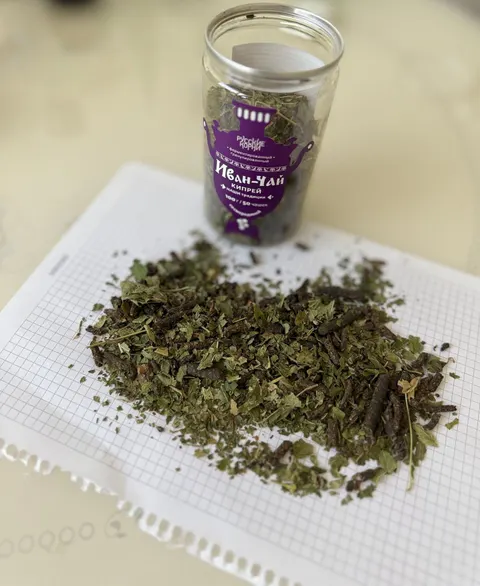
It comes in a clear jar, and the label is in Russian. The brand is Russkie Korni (“Russian Roots”). It says fermented and granulated, Ivan-chai, kiprei — kiprei is the Russian name for fireweed — and with blackcurrant. So even the jar I drink now is not pure fireweed: it is a blend, and you can see it when you pour it out on paper — crumbled leaf, small granules and blackcurrant leaves. The label also says 100 g makes 50 cups, which works out at about 2 g a cup. I don’t weigh it, though.
My glass teapot
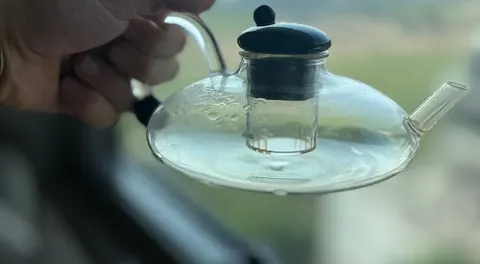
I don’t even remember how this teapot appeared in my life. I liked it, so I bought it. It is glass, with an infuser in the middle.
Pavel’s own tea table
I brew ivan chai by eye, without scales. You put the tea into the infuser. When you decide it is enough, that it has brewed, you pull the infuser out, put it in the sink, and then you drink clean tea. I brew my Turkish black tea roughly the same way. Other everyday pots and cups I use are on choosing tea ware, and all my teas are on Pavel’s teas.
Pavel’s own teapot for ivan chai
Everything above is my own experience. Below is reference material, with sources.
A different plant in the tea cupboard
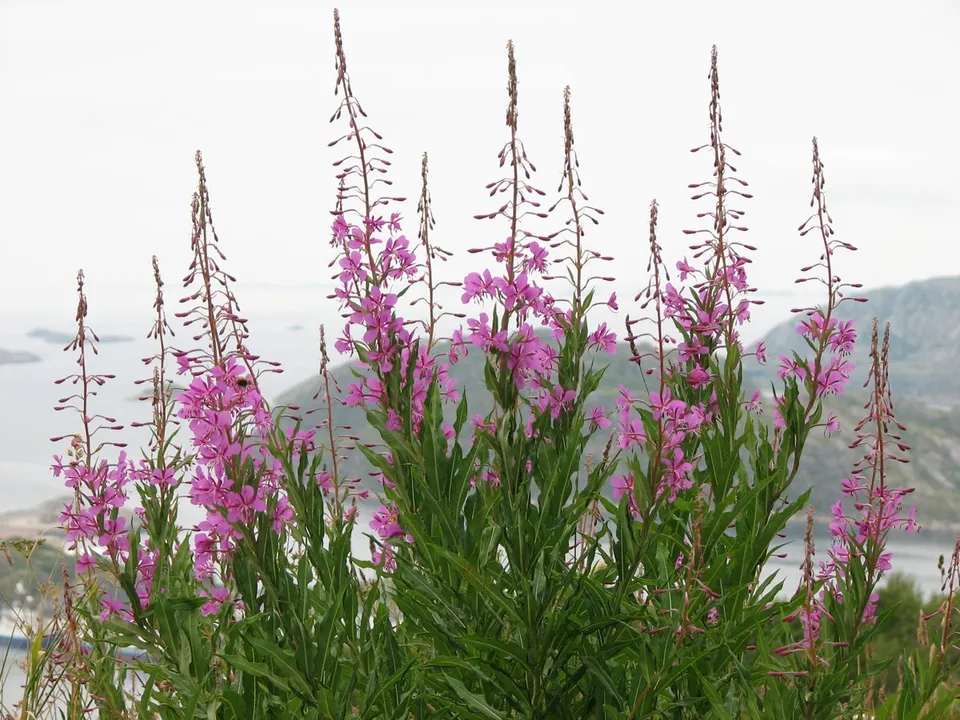
Fireweed photographed near Bodø, Norway, in 2009. Botanical context only; this photograph is not a foraging identification guide or a finished tea product.
Pu-erh, Da Hong Pao and Tieguanyin are made from the tea plant, Camellia sinensis. Ivan chai comes from fireweed, Epilobium angustifolium, a flowering plant also called rosebay willowherb. On a label or in a book you may see Chamaenerion angustifolium or Chamerion angustifolium; these names reflect different taxonomic treatments, and Kew currently lists the first as a synonym of Epilobium angustifolium [1, 2].
A product labelled “willowherb” is not necessarily a single-ingredient fireweed drink. Other Epilobium species occur in commercial herbal products, and many packets combine fireweed with ordinary tea, fruit, berry leaves or other herbs [3, 5]. Look for a scientific plant name and a complete ingredient list rather than the large print on the front.
Why it is also called Koporye tea
The name Koporye tea (in Russian, koporsky chai) comes from the village of Koporye near St Petersburg, where fireweed was gathered and processed into a tea-like drink [8, 9, 10]. The USDA plant guide also records fireweed leaves used as a tea substitute or addition in England and Russia, including a Russian drink it calls Kaporie tea [4].
Its history is less romantic than a legend on a packet. Koporye tea was a cheap substitute for expensive Chinese black tea, and it was often used to bulk up Chinese tea or to pass it off as Chinese tea, which gave it a poor reputation [9, 10].
How ivan chai is fermented
Commercial fireweed drinks are sold as fermented and non-fermented [5]. The descriptions of fermented ivan chai below differ in detail, but they follow the same order: the fresh leaf is broken up, held warm for a day or more while it darkens, and then dried.
An account from 1888. The Russian Wikipedia article on Koporye tea quotes several old descriptions. In one, from an agricultural newspaper of 1888, the leaves are scalded with boiling water and rolled, either between the hands or on a ridged board. They are packed into baskets and left on a well-heated stove for two or three days, where they ferment and lose their green colour, and are then dried in the oven; the hotter the oven, the blacker the tea. The same account says the leaves were sometimes rubbed with ash or damp peat to add weight and a black colour [9]. That is one reason Koporye tea earned its poor name.
A laboratory study from 2023. Researchers in Lithuania crushed and cut fresh fireweed leaves and packed them into glass containers, either closed or with a lid that let air through. They held them at 30 °C for 24, 48 or 72 hours, then dried them at 40 °C for 10 hours [6]. The time and the access to air changed the measured plant compounds. That is evidence about those samples, not a home recipe and not a health result from drinking the infusion.
So the word fermented on a jar tells you the leaf went through a step like this. It does not tell you how long the leaf was held, how warm it was kept or how it was dried, and it does not mean the cup contains live microorganisms [5]. If you want to compare packets, ask the maker: were the leaves rolled or crushed, how long were they held, how were they dried, and are they sold loose, cut or granulated? A dark infusion is not black tea just because it looks similar.
Read the whole ingredient list
Pure fireweed is commonly described as caffeine-free. That description should not be extended automatically to a blend that contains Camellia sinensis or other ingredients. If caffeine matters to you, look for an explicit statement on the finished product, and ask the producer when the label is unclear [3].
A 2026 study used several laboratory methods on seven commercial fireweed-containing beverages and found undeclared plant material in two of them. That small study does not tell us how common this is across the market, and it should not be used to accuse any other producer. It does show why traceable sourcing and accurate ingredients matter more than attractive packaging [5].
Before choosing a packet, check:
Is fireweed the only ingredient, or is this a blend?
Is the plant identified beyond a common name?
Can you identify the producer and the batch?
Are the storage and brewing directions readable?
Does the seller explain the product without promising treatment, detoxification or a guaranteed effect?
This page is not a foraging guide. Start with a food product from a traceable supplier.
Make a first cup you can repeat
Start with the directions on your packet. For dried herbal infusions in general, Germany’s Federal Institute for Risk Assessment recommends water at a rolling boil and at least five minutes of infusion [7]. Keep any longer time the maker gives, and do not borrow a cooler, shorter oolong recipe for a herbal product. Use a heat-safe cup or pot, keep boiling water and hot vessels on a stable surface, and let the drink cool before you taste it.
To learn a new packet, make the first cup exactly as instructed and taste a little plain. Write down the aroma, the main taste and how it feels in your mouth. Next time change only one thing the maker allows, such as the amount of leaf, and compare.
Frequently asked questions
Is Ivan chai caffeine free?
Pure fireweed is commonly described as caffeine-free [3]. A blend that includes Camellia sinensis tea will contain caffeine, so look for an explicit statement on the finished product.
What does Ivan chai taste like?
Fermented fireweed is described as a richly flavoured, deeply coloured herbal tea [8]. Packets differ a lot: blends add berries, fruit or herbs, and “fermented” does not mean one fixed flavour. In my experience it depends a lot on where it comes from.
Why is it called Koporye tea?
After the village of Koporye near St Petersburg, where fireweed was gathered and processed into a tea-like drink [8, 9, 10].
Is Ivan chai the same as fireweed tea?
Usually, yes. Ivan chai is a traditional name for an infusion of fireweed leaves; you may also see Koporye tea or rosebay willowherb on labels. Check the ingredient list, because many products are blends.
What does “fermented” Ivan chai mean?
The leaves were broken up, rolled or crushed, and held for a time before drying, so that they darken; old descriptions and a 2023 laboratory study both follow that order [6, 9]. The word does not describe one fixed method or flavour, and does not mean the cup contains live microorganisms [5].
How do I brew Ivan chai?
Follow the packet directions. For dried herbal infusions in general, Germany’s Federal Institute for Risk Assessment recommends water at a rolling boil and at least five minutes of steeping [7]. I brew mine by eye in a glass teapot with an infuser.
Sources
Royal Botanic Gardens, Kew. Tea plant and Camellia sinensis. Botanical identity only; this article does not adopt the page’s health claims.
German Federal Institute for Risk Assessment. Boiling water a must for herbal teas. Published 2005; preparation hygiene, not a claim that brewing repairs contaminated products.
Wikipedia (Russian). Копорский чай (Koporye tea). Revision 155780001, 24 October 2026; history of the name, its use as a substitute for Chinese tea, and the section “Способы производства” (methods of production), which quotes P. Solovyov, “Kaporsky chai”, Zemledelcheskaya gazeta no. 28, 1888. Checked 15 November 2026.
Russian Life. The Teas of Russia. 17 May 2021. The Koporye region and the use of Koporye tea to adulterate Chinese black tea; the article’s Alexander Nevsky story is a legend and is not used here.