This guide does not name a best material for a teapot or rank materials. It says the cup you actually make matters more: the amount of water, how you stop the infusion and how the filled vessel feels in your hands. Porcelain, glazed ceramic, glass and unglazed clay are broad families that do not specify wall thickness, weight, lid fit or suitability for boiling water, so follow the maker’s instructions. For functional pottery, choose a reliable maker and clear food-use information; FDA warns that lead in some improperly manufactured ceramic glazes or decorations can migrate into food and drink.
Choose tea ware around the cup you actually make: the amount of water, how you stop the infusion and how the filled vessel feels in your hands. Those details matter more to the routine than owning a particular kind of pot.
A favourite mug may already do the job. Consider a gaiwan or small pot when its way of brewing and pouring answers a need you can name. The comparisons here are practical editorial guidance, not a ranking of materials or traditions.
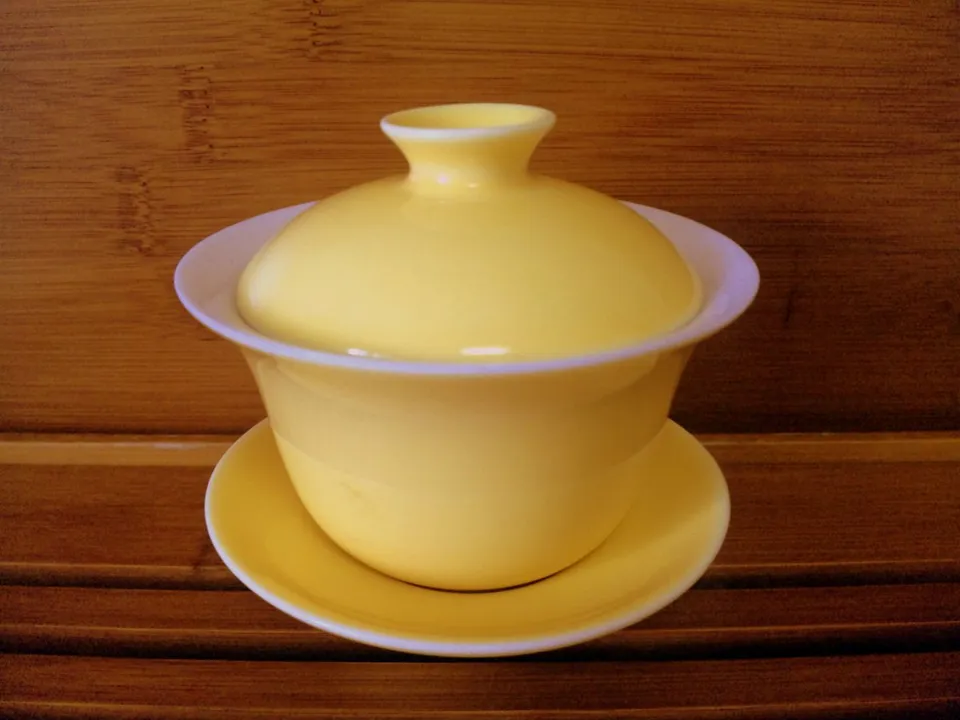
A gaiwan: bowl, lid and saucer. This illustrates the vessel, not a named tea.
Gaiwan yellow shizuhaused 01 — Shizuha. CC BY-SA 3.0. Proportional resizing and WebP conversion; no crop or retouching. The original licence also applies to these derivatives.
Begin with the everyday cup
Think about one normal occasion. Are you making a full cup while working, sharing tea with another person or sitting down for several small infusions? How much water do you actually pour, leaving comfortable space below the rim?
Measure your working volume once, leaving room below the rim. Compare that with the seller’s stated capacity, which may be brim-full. Start with a heat-safe cup you already like and check whether any added basket stays securely in place.
A basket infuser makes stopping simple
A removable basket separates brewing from drinking without requiring a second vessel. Lift it out at the chosen time and the leaves are no longer sitting in the cup’s water. Choose a basket with enough usable space for your usual leaf portion to open, rather than filling a tiny container tightly.
Look at the holes as well as the size. A fine tea can escape through openings that work well for larger leaves. Conversely, very fine mesh may take more effort to rinse clean. Check how the basket drains and whether its handle or tabs can be touched safely according to the manufacturer’s instructions.
Check the basket against your usual water level and the cup’s rim before buying it. It needs to reach the water, remain supported and have a heat-safe place to rest after removal.
A small pot makes pouring part of the method
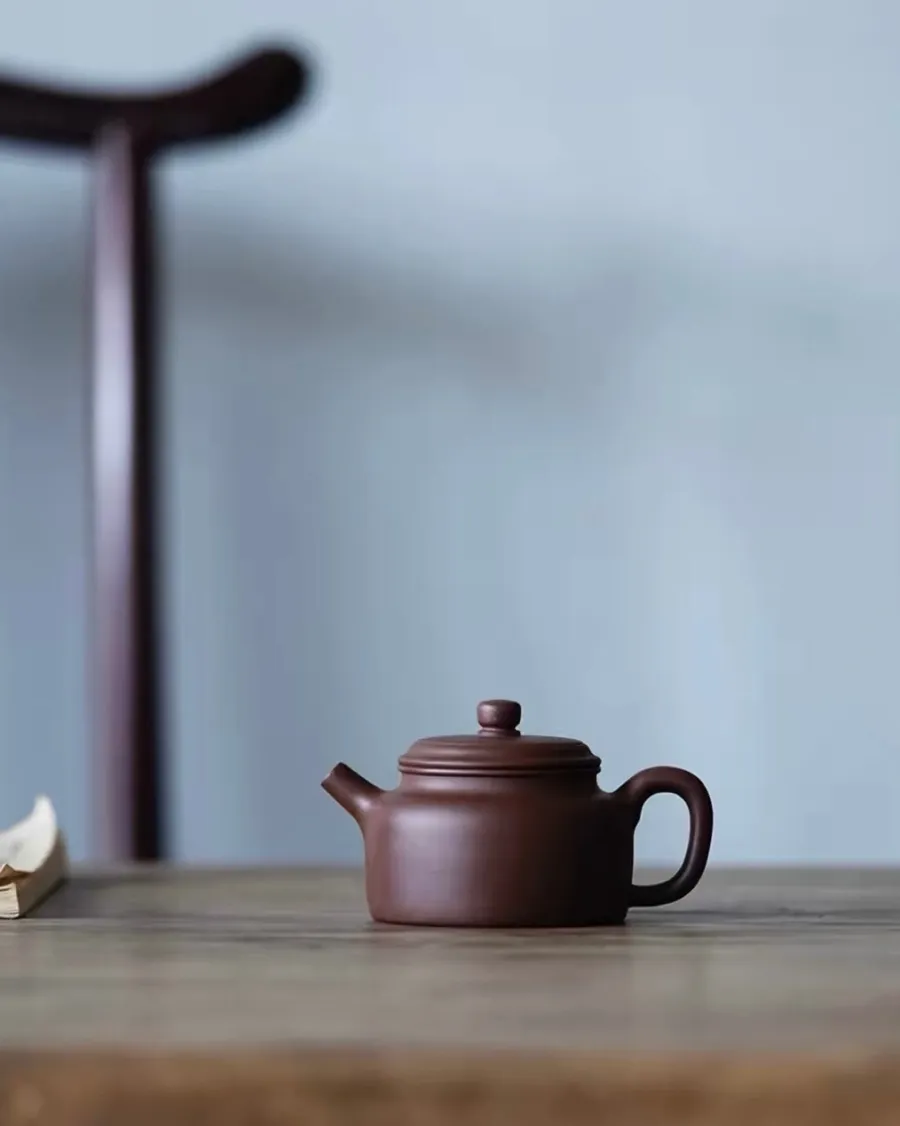
A handled pot can be comfortable for short infusions or for sharing a modest amount of tea. The useful capacity is the amount you want to decant at once. If you routinely make one small cup, a much larger pot may be awkward to use consistently.
Pay attention to the filled weight, handle clearance, lid security and spout. Can you pour without twisting your wrist sharply? Does the stream go where you expect? Can you empty the pot without putting a finger near escaping steam?
For a timed infusion, pour the tea into another heat-safe vessel or divide it between cups when the time is up. A pot left partly full continues to hold water against the leaves. Also allow for the time needed to empty it: a very slow pour is part of the actual brewing process.
A small handled pot: the Dezhong 135 ml Yixing zini teapot. This illustrates the form, not a recommendation to buy this product.
Photo: Oriental Artisan. Used with permission; proportional resizing and WebP conversion, no crop or retouching.
A gaiwan asks for a different kind of handling
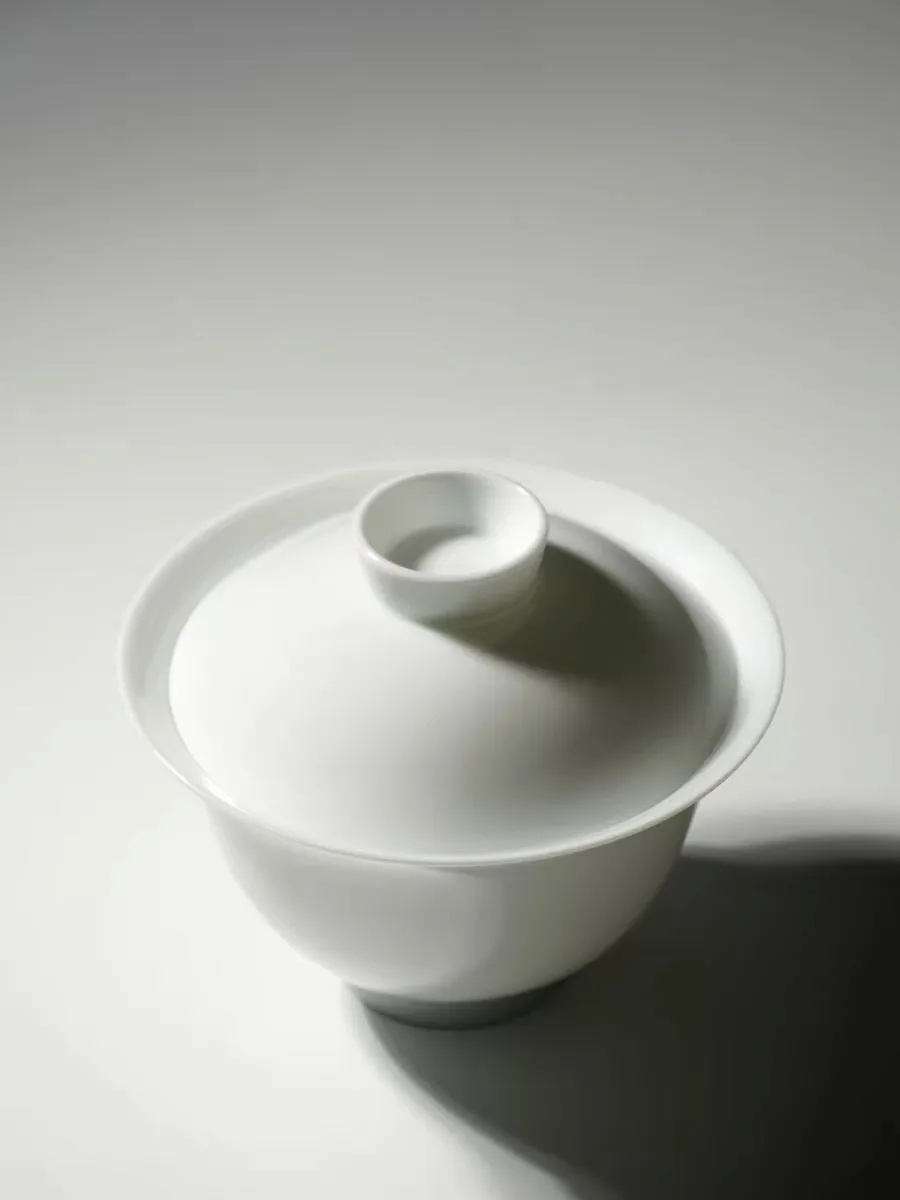
A gaiwan is a covered bowl, commonly used with a saucer. A historical covered cup and saucer in the Metropolitan Museum of Art’s collection documents this three-part form. [1] It gives easy access to the leaves, with no narrow pot opening to work around.
For decanting, the lid is positioned to leave a gap while keeping most leaves inside. That means managing a hot bowl and a separate lid together. Choose a size that fits your hand.
Practise filling and pouring with cool water over a sink before brewing. Leave room below the rim and keep the receiving vessel close on a stable surface. If the grip feels precarious, use a handled pot or basket instead.
A thin white porcelain gaiwan: the Cloudlight eggshell porcelain gaiwan. This illustrates the vessel, not a recommendation to buy this product.
Photo: Oriental Artisan. Used with permission; proportional resizing and WebP conversion, no crop or retouching.
Oriental Artisan offered Good & Steady readers 20% off any item with the code goodandsteady. We earn nothing from it.
A pitcher keeps the cups even
In gongfu-style brewing, tea is often poured from the pot or gaiwan into a pitcher first, and only then into the cups. In Chinese it is called a chahai (茶海) or gongdao bei (公道杯, “fairness cup”); it is also sold as a fairness pitcher. Emptying the brewing vessel into the pitcher stops the leaves steeping, and pouring from one pitcher means every cup gets tea of the same strength. [5]
This is the “other heat-safe vessel” from the teapot section above, made for the job. The same handling checks apply: a stable base, a spout that pours where you expect and a rim you can hold without touching the hottest part.
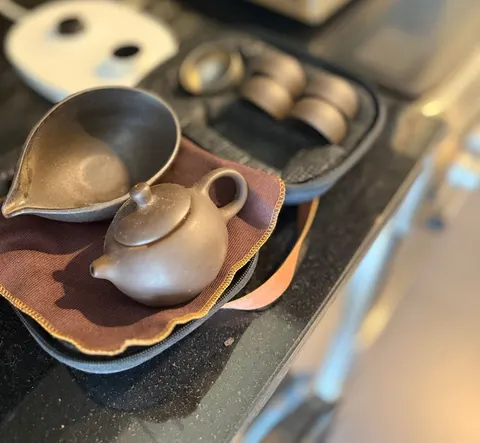
My travel tea set: a clay teapot, a pitcher and small cups in a case. I use the same set at home.
Read material claims with proportion
Porcelain, glazed ceramic, glass and unglazed clay describe broad families of objects. They do not specify a particular vessel’s wall thickness, weight, lid fit or suitability for boiling water. Follow the maker’s temperature, cleaning and appliance instructions; do not assume ordinary glass is designed for hot brewing or that a metal-looking pot belongs on a stove.
There is also a difference between an admired object and verified everyday tableware. The Metropolitan Museum’s plum-blossom-shaped Yixing teapot shows how sculptural a tea vessel can be. Its collection record documents that particular object’s material and history, rather than promising that a material improves every tea. [2]
For functional pottery, choose a reliable maker and clear food-use information. FDA warns that lead in some improperly manufactured ceramic glazes or decorations can migrate into food and drink. Decorative-only pieces should not be used for serving. Washing or boiling cannot remove lead from pottery or make an unsafe piece suitable for tea. [3]
Keep the price and the handling question separate. Design, labour, decoration, provenance and collectability may all affect price, but none tells you whether the pot fits your hand. Leave an unexplained authenticity or material claim unresolved rather than using price as its proof.
A five-minute suitability check
With a vessel you own, use cool water to check:
Your comfortable working volume, rather than the brim-full capacity
Stability on the surface where you normally brew
Grip and filled weight, including how you place the vessel down
Pouring or basket removal, with a safe resting place for wet parts
Access for cleaning and whether every part can dry properly
For an online purchase, turn the same checks into questions about dimensions, weight, care and a pouring demonstration. Name the improvement you expect before buying. It may be a better-fitting basket—or you may find that the cup you already use needs no replacement.
From Pavel’s tea table
Personal experience — Pavel Rachkouski, founder. One person’s notes, not advice.
My first real pu-erh, around 2014–15, was a ten-year-old one. Understanding nothing, we put half a cake into a one-litre metal mug and boiled it with an immersion heater for about 40 minutes. What came out was something like chifir. If you are just starting, I would get a cup, a teapot and a gaiwan; there are travel sets with a gaiwan and a cup in one. Use them for a while and see whether you need tea at all, and only then look further. My own teapot cost about 250 dollars; I have heard there are teapots for 10,000 dollars. Clay is best. Choose for the tea: pu-erh needs one thing, GABA another. For ivan chai I use a glass teapot with an infuser in the middle. I think porcelain suits pu-erh: it is clingy, and porcelain is easy to wash afterwards. A clay teapot is better kept for one kind of tea, because it soaks up the taste. To spend less, there are small sets.
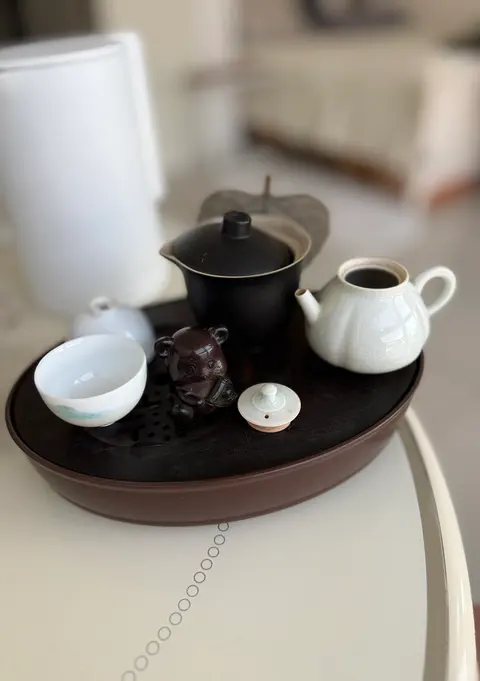
The two white cups and the white teapot I bought, I think, at a tea mall in Dubai, in the same shop where I bought my milk oolong. The black gaiwan I ordered online, I think from Amazon; my travel set, I think from Noon; the electric kettle from Amazon too. The thermos I went to a shop for myself and chose it there.
The white cups and the white teapot I bought, I think, at a tea mall in Dubai.
I have a pitcher with no lid, and it’s inconvenient: the tea in it cools quickly. I would advise taking one with a lid, so people don’t buy one without a lid, because the tea cools fast.
The kettle shows 97 °C; I pour the water into the thermos; the thermos cools it by another couple of degrees, and I pour it onto the leaf at around 95.
One more thing for a beginner. I made a mistake: I bought a pitcher, and I bought it online, on Noon. In general it’s better to go and choose tea ware in person and look, I suppose, at the thickness. My camping cups, say, are brilliant, and these white ones are basically brilliant too, even with hot tea. But the pitcher: if I pour boiling water through it, say two pots’ worth, then with pu-erh, which I brew at 98 degrees, the pitcher burns my fingers. So I would choose thicker tea ware.
Pu-erh soaks in, I think, so for pu-erh I would keep separate tea ware. For GABA and teas like that I would take porcelain, which is basically what I have, though I brew GABA in the black one too. Purple pu-erh I try to brew in clay: I have a black teapot, and it is clay. It soaks up the taste, so it is better to brew one tea in it. In porcelain you can brew different ones: it washes clean and doesn’t take on smell. That is my observation.
I sometimes take the gaiwan when it’s just the two of us, my girlfriend and me: I don’t feel like bringing the teapot, so I take the gaiwan and pour from it. Mugs, no: I use them only for coffee; I don’t drink tea from mugs. The difference between the gaiwan and my clay teapot is, I suppose, that the gaiwan is bigger, and somehow it doesn’t hold the heat the way the teapot does. And that’s it; beyond that there is no big difference. My girlfriend and I are hardcore people: in the morning I can put in about 6–7 grams, and if we are going out somewhere, ten, even 12.
My travel teapot, to be honest, is a lousy one: water seeps out from under the lid at the same time as it pours from the spout. And if you don’t hold the lid and tip the teapot far, the lid flies off. I bought it on some marketplace. So when you choose a teapot, make sure the lid holds and it doesn’t leak.
Besides choosing in person, you can watch teapot reviews on YouTube, where people brew in them, the kind of thing I do. For a beginner it’s better to buy porcelain straight away: it doesn’t soak up smell or taste. You can brew pu-erh in it, and GABA, and Da Hong Pao, and Tieguanyin.
However much tea I have drunk and however many people I have met, I have been struck by this: everyone’s own tea ware is the very best. The best teapots, the best gaiwans; you couldn’t come up with anything better. And only the place where they buy their tea has the very best, the tastiest tea. I have travelled around the world a fair bit: I met a lot of tea drinkers in Turkey, and quite a few in Dubai. And wherever anyone buys, the best tea shops are the ones where they buy.
Frequently asked questions
What is the best material for a teapot?
This guide does not rank materials. It says porcelain, glazed ceramic, glass and unglazed clay describe broad families of objects, and its Yixing teapot example documents one object rather than promising that a material improves every tea. It points you to the cup you actually make: how much water you pour, how you stop the infusion and how the filled vessel feels in your hands.
Can I use a glass or metal teapot with boiling water or on the stove?
Follow the maker’s temperature, cleaning and appliance instructions. The guide says not to assume ordinary glass is designed for hot brewing or that a metal-looking pot belongs on a stove.
Is there a lead concern with ceramic teapots?
For functional pottery, the guide says to choose a reliable maker and clear food-use information. It cites FDA’s warning that lead in some improperly manufactured ceramic glazes or decorations can migrate into food and drink. Decorative-only pieces should not be used for serving, and washing or boiling cannot remove lead from pottery or make an unsafe piece suitable for tea.
How do I choose the size of a teapot?
Measure your comfortable working volume once, leaving room below the rim, and compare it with the seller’s stated capacity, which may be brim-full. With a vessel you own, use cool water to check stability, grip and filled weight, pouring and access for cleaning.
Does the price tell me whether a teapot suits me?
The guide keeps price and handling separate: design, labour, decoration, provenance and collectability may all affect price, but none tells you whether the pot fits your hand. It says to leave an unexplained authenticity or material claim unresolved rather than using price as its proof.
Gaiwan or teapot: which should I choose?
Consider a gaiwan or small pot when its way of brewing and pouring answers a need you can name. A gaiwan gives easy access to the leaves, but decanting means managing a hot bowl and a separate lid together; if the grip feels precarious, use a handled pot or basket instead.
Can you drink directly from a gaiwan?
Yes. A gaiwan is a lidded bowl with a saucer, used both to infuse the leaves and to drink from. Tea can be drunk straight from the bowl, traditionally using the lid to hold the leaves back, or poured off into another vessel. [6] The bowl gets hot, so the handling advice above applies either way.
Is a gaiwan Chinese or Japanese?
Chinese. The gaiwan (蓋碗, literally “lidded bowl”) appeared during the Ming dynasty (1368–1644); before that, tea was usually drunk from the vessel it was prepared in. [6] The Metropolitan Museum’s Qianlong-period covered cup and saucer shows the same three-part form. [1]
Why are Yixing teapots so expensive?
Prices vary widely. Price depends on factors such as age, clay, artist, style and production method; the more expensive pots are shaped by hand with wooden and bamboo tools, while cheaper ones are slip-cast in moulds. [7] Price still says nothing about whether a pot fits your hand, and it is not proof of an authenticity or material claim.
Sources
Metropolitan Museum of Art. Covered Cup and Saucer. Chinese porcelain, Qianlong period (1736–95), object 14.40.254a–c. Museum collection record used to document the covered-cup-and-saucer form; checked 16 October 2026.