Everyday cooking
Spinach Scrambled Eggs on Toast
Originally published · 16 October 2026
Jump to ingredients ↓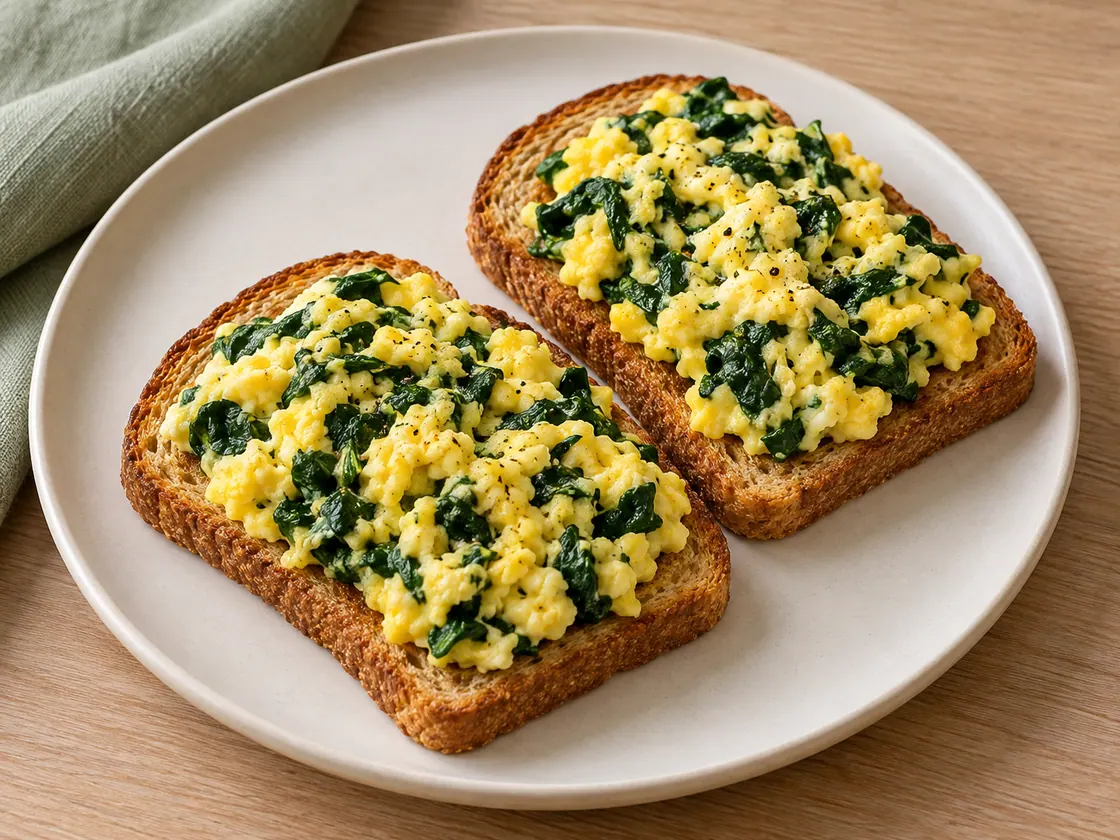
Prepare the spinach before it meets the eggs: cook it according to the packet, then drain away excess liquid. That separate step lets you manage both cooking and texture instead of adding a wet frozen block to the scramble. Eggs and toast complete this short ingredient list.
To make spinach scrambled eggs on toast, cook frozen spinach by its packet directions, drain it well and press out the water, then stir it into 4 beaten eggs as they softly set in a little olive oil. Serve on 4 slices of toast for 2 people. Draining the spinach first is what stops the scramble from turning watery. Total time is about 20–26 minutes.
Recipe at a glance
- Approximate servings: 2 servings, each with half the scramble and 2 slices of toast
- Preparation estimate: 8 minutes
- Cooking estimate: 12–18 minutes, including the spinach; its packet directions may take longer
- Total estimate: 20–26 minutes
- Equipment: scales, saucepan or microwave-safe container required by the spinach packet, sieve, heatproof bowl, fork, 24 cm nonstick frying pan, spatula, toaster and a clean food thermometer suitable for thin foods
Ingredients
- 150 g frozen chopped spinach, weighed frozen
- Water for cooking the spinach, in the amount specified on its packet
- 4 large eggs
- 1 tablespoon water for the eggs
- 2 teaspoons olive oil
- 4 slices of bread, approximately 35–45 g each
- ⅛ teaspoon fine salt, optional
- ⅛ teaspoon ground black pepper
Choose plain frozen spinach, without cream sauce. Divide the scramble across the bread slices you intend to serve; slice sizes vary, so the two-serving yield is approximate. This formula needs neither milk nor butter, and the salt remains optional.
Method
- Cook the spinach. Follow the packet’s cooking instructions completely, using the required water and any standing time. Drain in a sieve over a heatproof bowl. Press gently with a spoon to remove excess water; do not squeeze hot spinach with your hands. Break up any compact clumps. The packet method takes priority over this recipe’s time estimate. FoodSafety.gov guidance on frozen-food instructions
- Prepare the eggs. Crack the eggs into a clean bowl. Add the tablespoon of water, pepper and optional salt, then beat with a fork until combined. Wash your hands and clean any utensils or surfaces that touched raw egg before handling the toast or serving dishes. FDA egg guidance
- Make the toast while the eggs cook, or just beforehand if one task at a time is easier to manage. Set it on two clean plates.
- Scramble. Heat the oil in the frying pan over medium-low heat. Add the drained spinach and stir for about one minute to separate it across the pan. Pour in the eggs. Use the spatula to draw the setting egg from the edge toward the centre, then gently fold the curds over. Continue over gentle heat until the eggs are set throughout with no runny egg remaining. As an egg-and-vegetable dish, check for at least 160°F/71°C with the thermometer; gather the mixture sufficiently for its sensing tip and avoid touching the pan. Expect roughly 4–7 minutes, but use the endpoint rather than the clock. FDA egg guidance
- Serve. Divide the scramble over the toast and eat immediately. If the spinach releases liquid, lift the scramble with the spatula rather than pouring the pan contents over the bread.
Leftovers
This is planned as a cook-and-eat breakfast. If you save some scramble, refrigerate it promptly in a shallow covered container at 40°F/4°C or below, within two hours, or one hour above 90°F/32°C. Use within 3–4 days. Reheat to 165°F/74°C throughout, checked with a thermometer, and make fresh toast. Keep the storage container separate from bread you plan to toast later. FDA egg storage and serving guidance
Allergens and labels
Contains egg and, with ordinary wheat bread, wheat. Bread can also contain milk, soy or sesame. Check every package and substitution; a short recipe allergen note cannot replace the full ingredient information. FDA label guidance
Put it in your meal plan
Allow a morning with time for the hob and toaster. Check the freezer before shopping: you may already have bread and the required 150 g of spinach, without needing to plan around a whole bag.
Keep this recipe in your own meal plan, with its quantities beside your shopping list. Build My Meals offers its own preset meal ideas; it does not import this recipe or add it as a custom meal.
From Pavel’s experience
Personal experience — Pavel Rachkouski, founder. One person’s notes, not advice.
Mostly my girlfriend does the cooking; I cook only once in a while. Then it’s by mood: I might make poached eggs, scrambled eggs, or just fry a couple of eggs. I like all kinds of cheese, prosciutto and meat, so I put together a plate like that for myself and eat. I don’t cook any particular dishes.
My favourite is when she makes something like an English breakfast. It isn’t quite English, but it’s very close. I really like the hash browns the way she makes them, and I like it when there are little sausages and prosciutto.
Frequently asked questions
How do I stop spinach making scrambled eggs watery?
Cook the spinach separately first, then drain it in a sieve and press out excess liquid with a spoon before it meets the eggs.
Can I use fresh spinach?
This recipe was written for frozen chopped spinach. Fresh spinach also needs wilting and draining first; amounts and times will differ.
Do I need milk or butter?
No. This version uses a tablespoon of water and two teaspoons of olive oil.
How do I know the eggs are cooked?
Cook until no runny egg remains, then check the mixture with a clean food thermometer: at least 160°F (71°C), as in the method on this page.
Sources and recipe notes
Published method comparison: Scrambled Eggs with Spinach and Feta (Budget Bytes). We use packet-cooked frozen spinach, olive oil and toast, without feta. Frozen and fresh spinach weights differ. Cook eggs fully; do not rely on residual heat. The instructions here are our own version; source ratings, nutrition values and timing claims do not describe it. Safety links support the handling advice. Times and servings are approximate; packet instructions and cooking endpoints take priority.