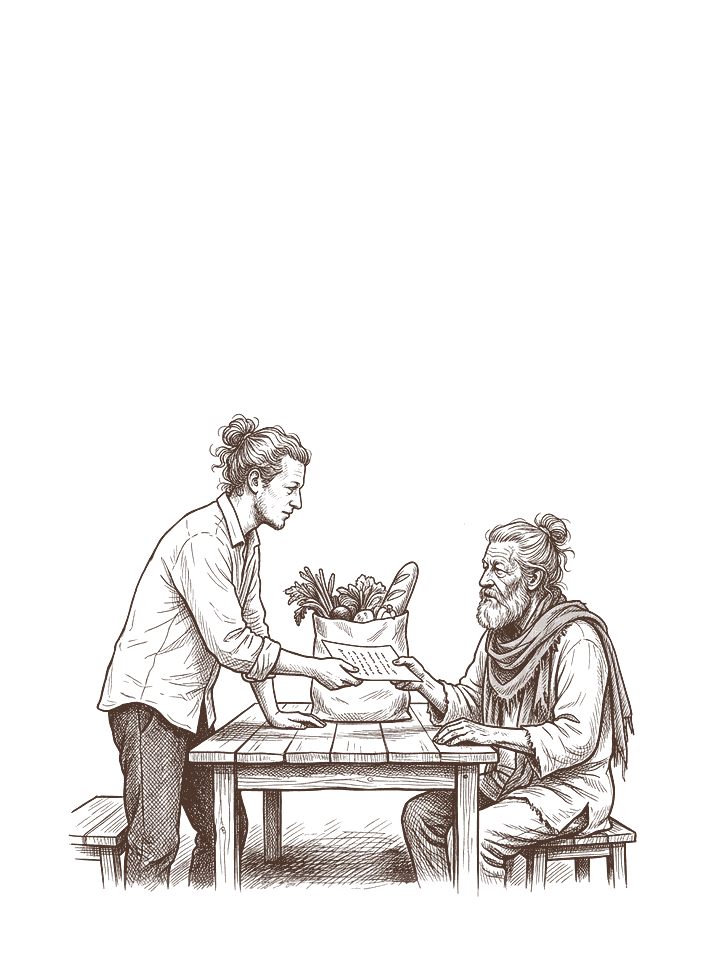
Give the other person a task they can answer. “Could you collect the groceries on Thursday?” leaves a practical decision in front of them. “I need more support” may describe your situation accurately while still leaving that decision undefined.
If work, family and caring responsibilities overlap, explaining the whole situation may be more than you have time for. Start with one ordinary task and leave room for the other person to say what they can manage. You are seeking an agreement, not measuring how much they care.
The NIH’s caregiver guidance suggests identifying specific ways people could help and considering their interests and availability. The method below is our own way to organize that conversation; it has not been tested as a caregiving intervention. NIH: Caregiving.
Choose the part you want someone else to take on
Describe the task for someone who has not done it before. Shopping could mean making a list, paying, collecting bags or putting food away; name the part you are asking them to take on.
For a first request, you could choose collecting an order you have already placed, taking your household’s recycling out, or finding the opening hours of a local service. A person who lives far away might be able to research two options and send you their details. That does not commit them to choosing a provider or arranging care.
Keep ordinary errands separate from tasks involving medicines, lifting, personal care, supervision or clinical decisions. This worksheet cannot establish who is trained, authorized or able to carry out those responsibilities. Ask the relevant care professional or service about the support they require.
Make the request small enough to answer
A clear request has four parts:
- The task: what would the person do?
- The boundary: where does their part finish?
- The timing: is there a particular day or a flexible window?
- The answer: when do you need to know whether they can help?
For example: “Could you collect our prepaid order on Thursday afternoon and leave it at our door? I can send the collection details. Please let me know by Wednesday evening so I can arrange something else.”
Say explicitly when the request is recurring. Agreement to one Thursday does not cover every Thursday; you can try one collection, then discuss whether a regular arrangement is possible.
Two requests for different situations
Someone nearby: You usually spend Saturday morning doing laundry and collecting groceries. You ask a neighbor about the collection only. They can help this week, but cannot promise another date. Your note says “Saturday collection confirmed; future weeks not agreed.” You have one useful commitment without assuming the whole morning has been covered.
Someone at a distance: A sibling asks what they can do. You ask them to find contact details, opening hours and eligibility information for two local support services. You agree that they will send the information on Sunday. You will make any inquiry about your family’s circumstances yourself. The research request does not require sharing medical records.
These are fictional examples of ordinary coordination. They do not establish that any care arrangement is suitable.
Your practical-help request sheet
Use one copy per request, on paper or in a private note. Leave out diagnoses and other details the helper does not need.
| Prompt | Your note |
|---|---|
| The specific task I want help with | |
| What the helper’s part includes and where it ends | |
| Who I will ask | |
| Date or flexible time window | |
| When I need an answer | |
| Their answer: agreed, declined or still open | |
| Details we still need to confirm | |
| If it cannot happen: who I will contact or what I will reconsider |
Use the final row for the next question if help falls through. It does not assign every unfinished task back to you. Another inquiry may be the realistic fallback, rather than a complete replacement solution.
Check what was actually agreed
Repeat the agreed task and time after a yes. If a smaller offer still helps, agree its limits; if the answer is no or absent, record that honestly. Silence cannot complete the agreement.
You can also ask how to flag a change. “Please tell me if the collection becomes impossible” is clearer than assuming plans will never move. The person receiving care should remain involved in choices that affect them, with their preferences and privacy respected.
The NIH’s caregiver checklist includes making a list of help needed and finding support. A worksheet cannot create available services, settle family disagreements or make an unsafe arrangement appropriate. If informal help is insufficient, ask an appropriate local service or the person’s care team about available support. Availability, costs and eligibility need checking locally. NIH caregiver checklist.
Keep the useful record, leave out the score
Once an ordinary household task is genuinely agreed, the Household Chore Chart can hold its short task, person and timing. Keep the fuller request sheet separately when you need the reply or fallback details. The chart does not send requests or manage a care plan.
Start with the next practical task. You do not have to distribute every responsibility before asking for one piece of help.
From Pavel’s experience
Personal experience — Pavel Rachkouski, founder. One person’s notes, not advice.
A friend of mine once broke his knee, and afterwards he couldn’t walk. For three months I went to see him, helped him get outside on crutches and spent whole days with him. He wasn’t bored: we spent the time together and hung out.