“Hot power yoga” combines two pieces of information. Hot describes a heated room. Power usually describes an active contemporary approach whose meaning is set by the teacher or school; Beryl Bender Birch’s Power Yoga, published in 1995, is a useful documented marker in the history of the name. A class can be one, the other or both, so ask how the class is organised and what room conditions it uses.
Read “hot power yoga” as two pieces of information. Hot describes a heated room. Power usually describes an active contemporary approach, with its meaning set by the teacher or school. A class can be one, the other or both; separate the environment from the teaching before deciding what the name tells you.
Where the labels come from
Power yoga is closely associated with the modern international yoga world. Beryl Bender Birch’s Power Yoga was published in 1995, a useful documented marker in the history of the name. Her school’s own account describes a method influenced by Ashtanga sequences and adapted for her students. That is the history of her approach, rather than evidence that every class now called power yoga follows it. Publisher record · The Hard & The Soft Yoga Institute
Bryan Kest’s website also uses Power Yoga as the name of his teaching approach. It acknowledges the term’s wider use for vigorous classes, while its own catalogue includes gentler sessions. Multiple uses of the same name are a reason to read a provider’s description closely. This article does not assign a single undisputed inventor to the generic label. Bryan Kest’s explanation
Heated classes also include distinct methods. Bikram’s official description specifies 26 postures and two breathing exercises, in a set order, over 90 minutes at 105°F, approximately 40.6°C. These details describe that system; they are not a definition of all hot yoga. A heated vinyasa class may use a changing sequence and a different duration or temperature. Bikram’s stated format · Hewett and colleagues: Published research protocol
What a class may be like
In a power class, expect the teacher’s description to explain whether movement flows continuously, includes longer holds, or follows a recognizable sequence. Baron Baptiste, for example, describes Journey Into Power as a consistent sequence whose intensity can be adapted. Other teachers arrange their classes differently. “Power” alone does not promise a particular set of postures, level of instruction or room temperature. Baptiste sequence framework
In a hot class, the room conditions are an additional part of the experience. Modo Yoga Etobicoke, for example, describes classes around 40°C with roughly 40 percent humidity, while noting that conditions can vary. That is a specific provider’s description, not a temperature standard for every studio using the word hot. A Modo studio’s class information
Keep two questions on your list: how is the class organised, and what room conditions does it use? A short timetable label can hide both. A fast sequence and a heated room remain separate features even when the class combines them.
Equipment and room details
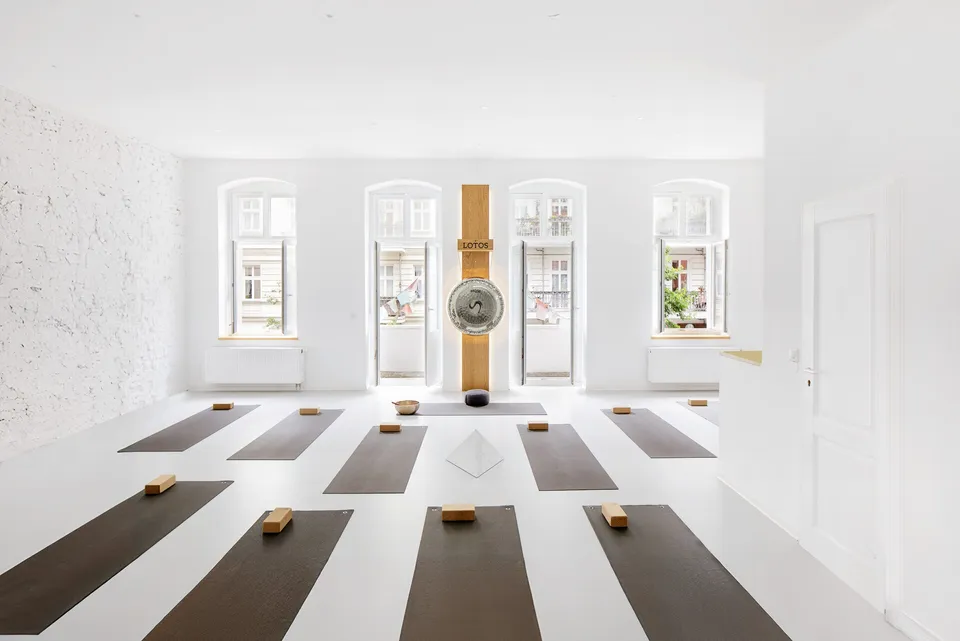
Get the equipment list from the provider. Ask which mats, towels, blocks or other props are supplied, how props enter the sequence and what facilities are outside the heated room. Those answers help you prepare for the actual visit; a studio photograph cannot give you the same information.
Heat is not evidence of a better session or a measure of personal progress. NCCIH notes that hot yoga carries particular risks of overheating and dehydration. That brief caution is important context; this article does not assess an individual’s ability to take part or present heat as a treatment. NCCIH yoga information
- What are the expected temperature and humidity?
- Is the class a fixed sequence, an adaptable framework or a different flow each time?
- How are unfamiliar movements explained, and what experience does the session assume?
- What is the arrangement for pausing or leaving the heated room?
- Which equipment is supplied, and is an unheated version of this class available?
Use the answers to build a description of the particular class.
From Pavel’s experience
Personal experience — Pavel Rachkouski, founder. One person’s notes, not advice.
I think I have tried almost every kind of yoga, including hot yoga in Dubai, on heated floors at around +60. It didn’t suit me, because everywhere you go, nobody connects anything for you: “sit down, breathe”, and they have 40 minutes. I think the main mistake of many teachers today is that not all of them can get the information across. People think that if they say something, it is understood, and that isn’t so. Some present it so that nothing is clear, and the person ends up misled.
In a hard stretch of life, a friend took me in for a month in Turkey. We practised twice a day: we got up while it was still dark, started the practice and finished at dawn; at sunset we started again and finished in the dark. In between we ate, walked, talked and drank tea, and I asked him about yoga and about what we were practising, for myself. He helped me a lot, and I am very grateful.
In Dubai, when it’s hot, I practise at home; when it’s just warm, I sometimes go to a good park here or to the beach, sometimes with my partner, sometimes on my own. My best practice in Dubai came after that month in Turkey: I went to the park alone, found a corner under a tree and practised so well that I liked it myself. The weather was lovely, the sun was setting, the birds were singing, and next door was a horse farm where the horses were calling to each other beautifully.
Frequently asked questions
Is hot yoga the same as power yoga?
No. Hot describes the heated room; power describes an active teaching approach. A fast sequence and a heated room remain separate features even when a class combines them.
What should I ask before a hot power yoga class?
The expected temperature and humidity, whether the class is a fixed sequence or a different flow each time, what experience it assumes, how you can pause or leave the heated room, and which equipment is supplied.
Does hot yoga have particular risks?
NCCIH notes that hot yoga carries particular risks of overheating and dehydration. Heat is not evidence of a better session; ask whether an unheated version of the class is available.